Many thanks to Hannah Kubaitis for her hard work composing & digitizing the following childhood stories.

The Escalator Adventures
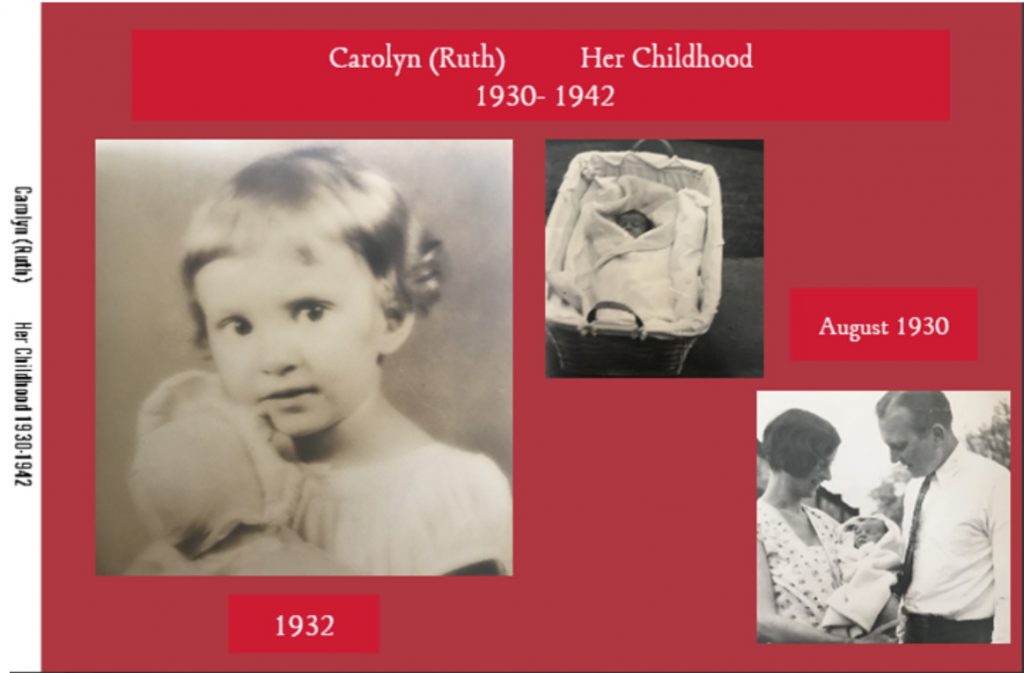
Carolyn was two and a half years old when she, Mother and Dad went to the Kaufman’s Department Store in Pittsburgh to go shopping. The ten-story building loomed over her at the intersection of Fifth Avenue and Smithfield Street. Carolyn clung to her mother’s hand as she navigated through the crowd to the entrance.
Men and women bustled around the store like army ants- each person dedicating to completing their own tasks. Although shopping with her mother and father was boring, Carolyn loved the escalators. Abe and Ruth trusted Carolyn enough to turn her loose while they did their shopping. Soon they disappeared into the crowd of bodies, leaving Carolyn at the newly installed escalators with strict instructions. Her small hands skimmed along the smooth wooden railings as the moving steps boosted her to the next floor up. Giddy, she got lost in joy of riding the escalators up and down, and up and down. Each time was just as exciting as the last. But then Mother and Dad came back.
Dad walked towards Carolyn and said, “Okay, we’re going home.” Carolyn protested, “No! I don’t want to!” Carolyn threw herself onto the dirty department store floor onto her stomach-her tantrum making quite a scene. She cried and screamed, pounding her fists onto the floor. She did not want to leave, and made sure everyone knew it. Passersby stared in disapproval. Immediately, her dad picked her up and placed Carolyn over his knee. He began to spank her, right there in the middle of the department store, which is not something that would be permissible today. Blurry from the swell of tears, her fake cries changed tenor and never again did Carolyn throw another tantrum.
First Playmates
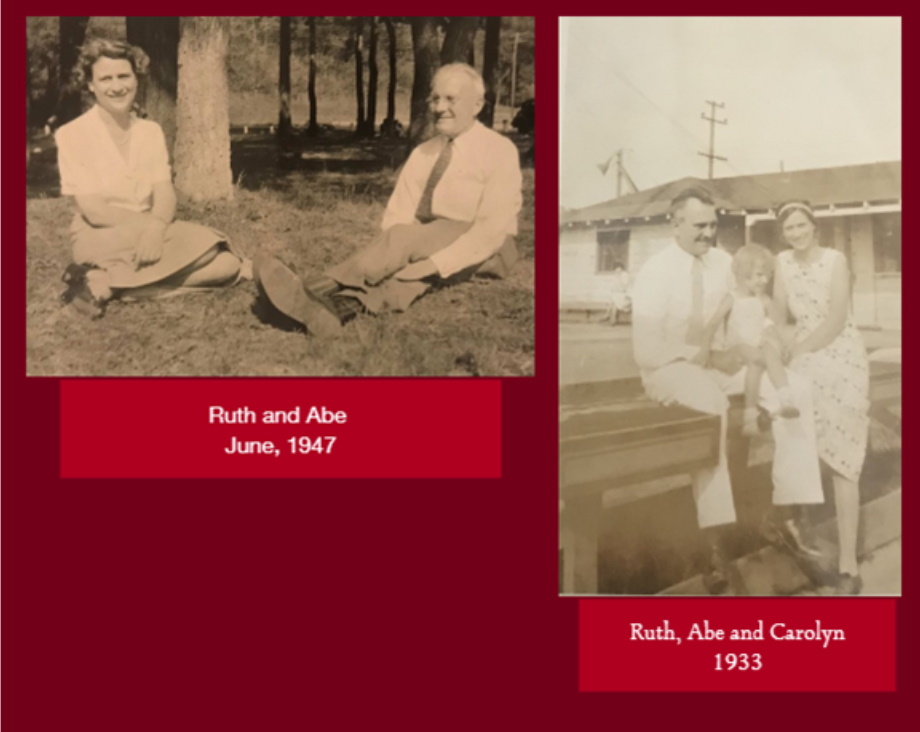
Carolyn’s childhood was filled with change. From birth to age twelve she moved nine times from Pittsburgh, PA to between Charleston, WV and Huntington, WV, living in nine different houses. This was challenging for Carolyn, the moving meant constantly making new friends. However, looking back Carolyn believes that this change was for the best. She was fortunate enough to have a stable home, where her mother and father were always a strong guiding education force and although the change was difficult, she values the experiences and varied adventures she had. Moving schools allowed her to interact with different people and learn how to make friends. She spent much of her time with her mother and with her father at home. They played games together, like Parcheesi, Chinese Checkers, Sorry and Monopoly. She enjoyed solitary projects like coloring books, playing with dolls, and playing with cut out dolls. Her favorite dolls were the Dy-Dee doll which you could feed a bottle and a Snow White doll she got at seven years old. Carolyn and her mother would go to the store to buy fabric and look at pattern books and deciding what clothes she wanted. Her mother was a professional grade seamstress and made all of Carolyn’s dresses and dance costumes. At four years old she idolized Shirley Temple and at age seven she admired the singers Jeanette MacDonald and Nelson Eddie. Despite moving, her mother sought to add some normalcy to her daughter’s life by encouraging her to take dance lessons.
With each move, Mother brought two brass candle sticks, a green fruit bowl, and a brass candelabra, which were fixated on the mantle of every house. This was a source of comfort for Carolyn through the moves.

The first time Carolyn and her parents moved to Charleston, WVa. they moved into a large beautiful house up in South Hills on Bridge Road. The house was near the top of the hill. It had eight large rooms and a huge full basement, with a steeply inclined driveway that ended at the bottom twenty feet from a wall with an abrupt ten foot drop off to a deep ravine and stream running below. From the driveway ran a path, which and wound up and over away from the back of the house and into the woods to a small cabin, where a little black girl lived, with whom Carolyn became friends with in 1933. The girls played many games together, just as children do, and it was this experience that planted in Carolyn the seeds of acceptance activism. Throughout her teen years, she spent much time working with the Methodist Church to try to integrate churches.
In 1937, Carolyn moved to Huntington for the first time and lived on West Forth Street. She was thrilled to find neighborhood girlfriends to play with. In March of 1937, Carolyn met her group of friends, neighbor girls around her age with whom she became very close. Claire Sue was Carolyn’s best friend who lived 5 doors down and Jacqueline lived in between. Martha Jane, who went by Cherry, was the youngest of the girls and she lived on the street behind Carolyn on West Fifth.
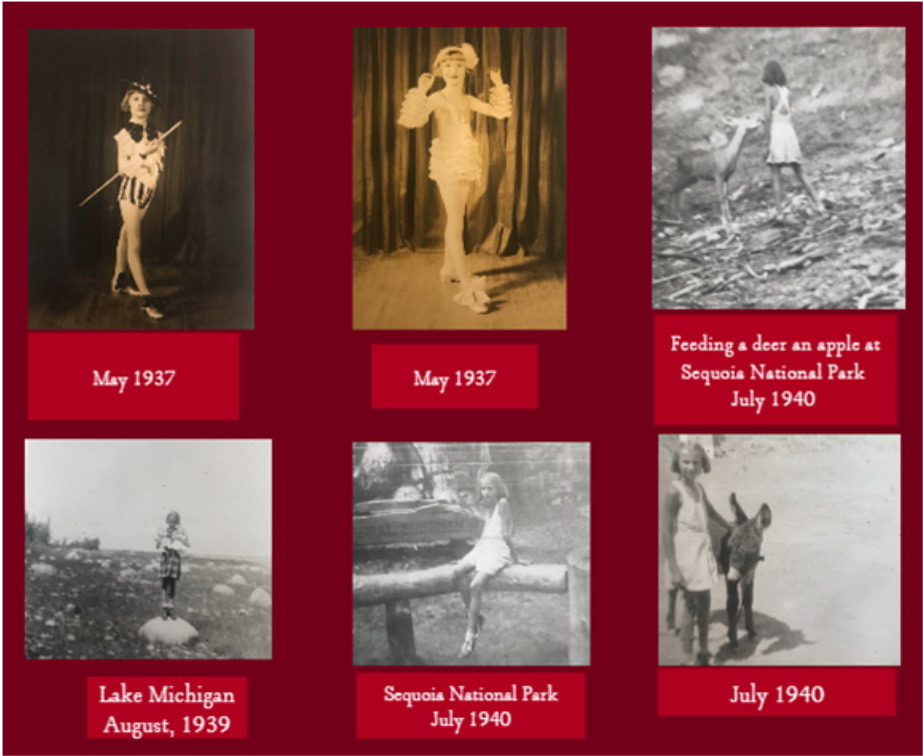
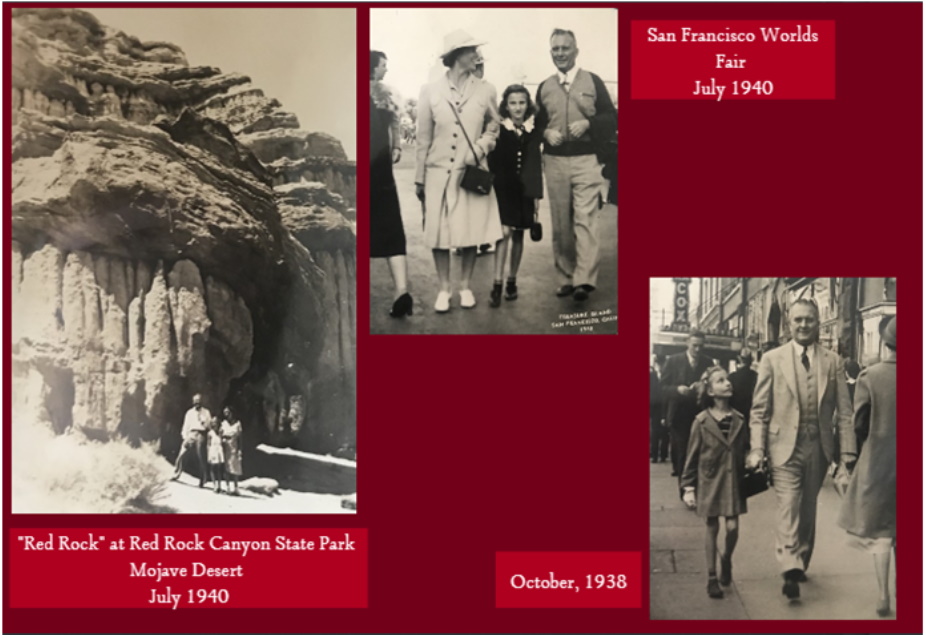
Carolyn grew up with very few playmates, and as mentioned before was very grown-up for her age. Her father was an intellectual man- a former school teacher and superintendent. Carolyn ’s childhood was filled with educational trips and experiences such as going to the San Francisco World Fair and tooling around National Parks along the way. Upon meeting Cherry for the first time, Carolyn exclaimed, “Oh, you’re Cherry, I presume.” The other girls were stunned, looking at her as if she had six heads, because it was surprising to hear a seven-year-old speak with such big words. Despite Carolyn having a more adult vocabulary than the other girls, they all got along well, and Carolyn was finally able to feel like a normal girl.
The first time Carolyn and her parents moved to Charleston, WVa. they moved into a large beautiful house up in South Hills on Bridge Road. The house was near the top of the hill. It had eight large rooms and a huge full basement, with a steeply inclined driveway that ended at the bottom twenty feet from a wall with an abrupt ten foot drop off to a deep ravine and stream running below. From the driveway ran a path, which and wound up and over away from the back of the house and into the woods to a small cabin, where a little black girl lived, with whom Carolyn became friends with in 1933. The girls played many games together, just as children do, and it was this experience that planted in Carolyn the seeds of acceptance activism. Throughout her teen years, she spent much time working with the Methodist Church to try to integrate churches.
In 1937, Carolyn moved to Huntington for the first time and lived on West Forth Street. She was thrilled to find neighborhood girlfriends to play with. In March of 1937, Carolyn met her group of friends, neighbor girls around her age with whom she became very close. Claire Sue was Carolyn’s best friend who lived 5 doors down and Jacqueline lived in between. Martha Jane, who went by Cherry, was the youngest of the girls and she lived on the street behind Carolyn on West Fifth.
Carolyn grew up with very few playmates, and as mentioned before was very grown-up for her age. Her father was an intellectual man- a former school teacher and superintendent. Carolyn ’s childhood was filled with educational trips and experiences such as going to the San Francisco World Fair and tooling around National Parks along the way. Upon meeting Cherry for the first time, Carolyn exclaimed, “Oh, you’re Cherry, I presume.” The other girls were stunned, looking at her as if she had six heads, because it was surprising to hear a seven-year-old speak with such big words. Despite Carolyn having a more adult vocabulary than the other girls, they all got along well, and Carolyn was finally able to feel like a normal girl.

The Broken Arm
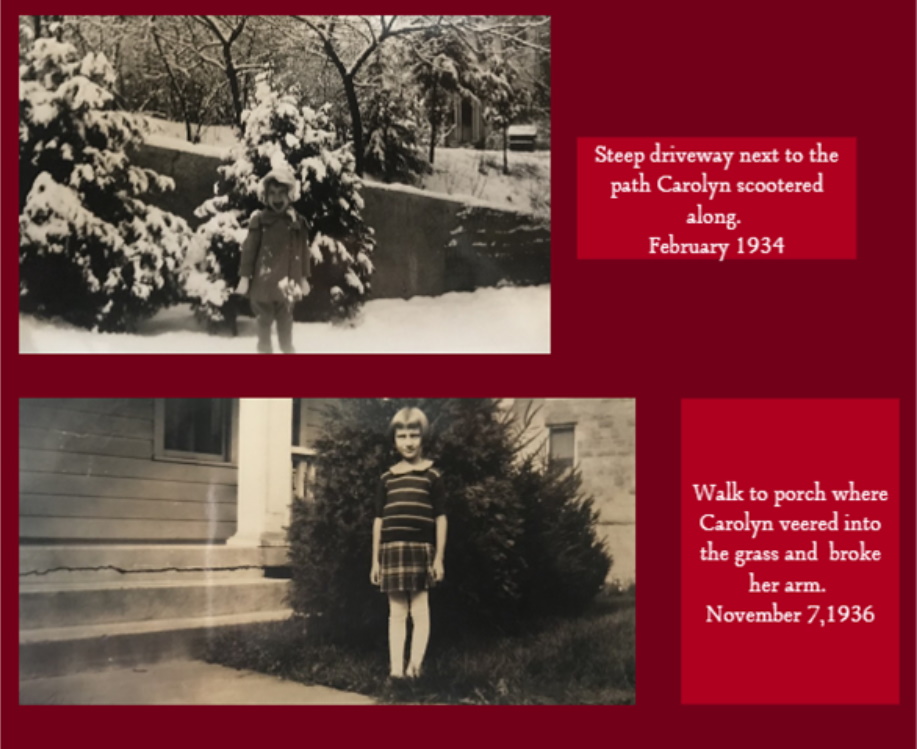
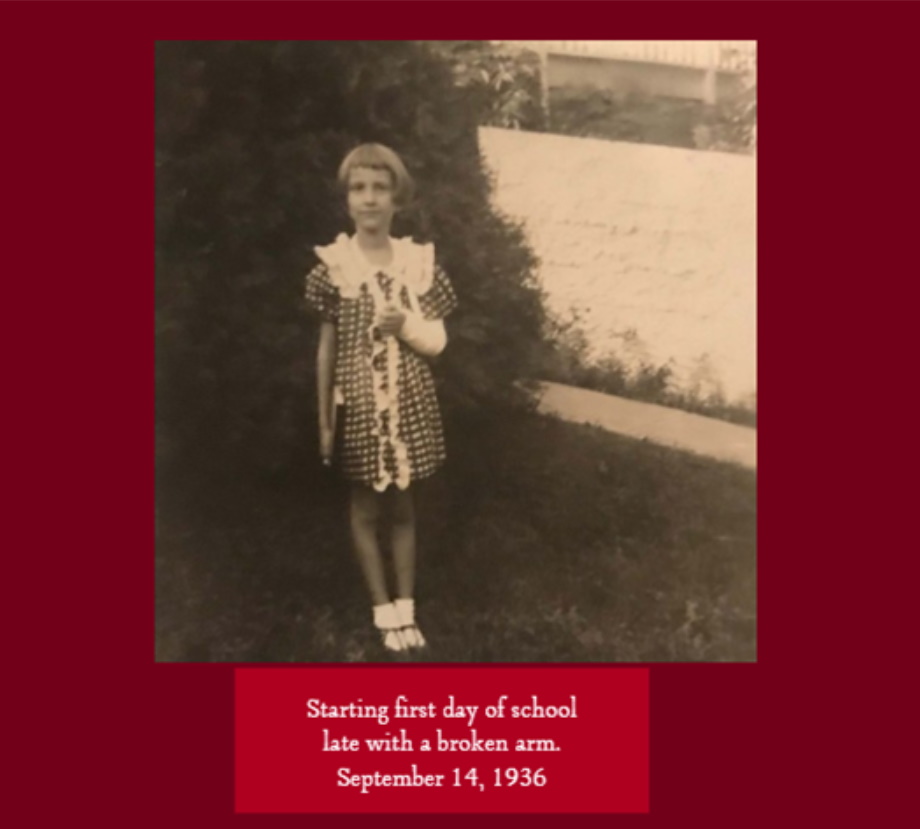
It was August of 1936, a month before Carolyn was to start school. The air was cool against her cheeks, and the ground was wet after a big rain. Following the storm Carolyn asked to scooter on the front walk. From the main road, her house sunk into a ravine. She started her ride on the walkway at the stairs which came down from the street. The walkway curved in an S shape, bending right and then left ending at the porch. As she rode her scooter down the walkway she picked up a lot of velocity and followed the S curve. Instead of crashing into the porch, she veered into the grass in the yard, so she could slow down enough until and hop off. Her super neat father had dug out a gulley and while veering into the grass, her wheel suddenly got twisted in the ditch between the side walk and the grass. Carolyn propelled in to the yard and as she fell she folded her elbow in and landed elbow first into the sod. Upon falling into the soft dirt, the bone in her left arm snapped, just above the joint in the forearm.
She screamed and yelled in pain. Her mother and her father came out to check what all the commotion was about. Her dad scooped her up into his arms and carried her to the car. Their house was located near the top of a hill and the roads were horrible- narrow and bumpy with not a lot of side rails. In the car, Carolyn held her arm in a V against her chest while her mother held her securely. Her father drove like a bat out of hell down the narrow winding road. The car sped down the road, lurching and bumping which strained poor Carolyn who was curled in her mother’s lap in agonizing pain. The South Side Bridge was closed for construction and they were forced to detour onto MacCorkle Avenue, a dirt road with only one strip of concrete down the middle, which made for very bumpy ride. Eventually they crossed the South East Bridge into downtown. Father drove towards a big dark red brick building, McMillan Hospital.
The building was basic and utilitarian four story brick building. Carolyn and her parents met her doctor and owner of the hospital, Dr. McMillan and the treatment of her arm began. Her arm was still incredibly swollen and painful as they went through the general procedure. Doctors and nurses shuffled Carolyn about, they took X rays and asked questions. It was so swollen that Dr. McMillan was not sure if he would be able to set it. Carolyn had to stay Monday through Wednesday for evaluation. Dr. McMillan finally told her parents, “The break is too close to the joint- I don’t think I can set this, so we may have to amputate the arm.” At that moment, Abe fell into a fit of rage, and almost tore up the hospital. He commanded to Dr. McMillan, “Absolutely not! You will not take off her arm. I don’t care if you bend it, so she can’t bend it for the rest of her life, you are not taking it off.” Dr. McMillan did the best that they could to reset it and as a result, Carolyn continues to have a fully functioning arm. Over the next 5-6 years, Carolyn’s X-rays and case became the subject of medical seminars and paper presentations at medical conventions for the correction of such an unusual break.
Carolyn was in a cast for six weeks after getting her arm set. She started school late, and registered for first grade on the last day possible, September 30th. When Carolyn was able to take off her cast, she had to do various exercises. There was not any physical therapy back then and the doctors gave her mother instructions as to how to care for and strengthen her arm. Carolyn was instructed to lie flat on a bed with an iron doorstop tied to her wrist. It was five inches long and an inch wide with a Bronco horse rearing back. She repeatedly curled her arm with this heavy iron doorstop tied to her wrist until she gained her strength back.
Summers on the Farm with Grandmother and Granddaddy Brown
In 1933, Mother and Dad went to the Chicago World’s Fair for a few days. It was the first time they left Carolyn alone with Grandmother and Granddaddy Brown at the farm. A visit to the farm happened every summer, for two weeks or more. Granddaddy owned several hundred acres of land and two barns. The first barn contained the pig pens and was where they slaughtered pigs each year. There were many acres of tobacco and corn were grown. The tobacco was stripped in the barn and hung from the rafters to cure. The second barn was a bit more appealing as it held one tractor and all of its attachments, Cows and horses. . Granddaddy owned around eight cows and every morning and evening he milked them. He brought the cows into the stalls which smelled of fresh hay and tied them up to be milked. Granddaddy grabbed the milk stools and taught Carolyn from a her young age how to milk a cow. By the time Carolyn was about six or seven years old, she could milk a cow on her own. Prior to those years, her hands were too small and too weak. One thing Carolyn loved most about milking was being able to drink warm fresh milk straight from the cow’s utter. To this day, she cannot drink plain white milk because it pales in comparison to the delicious unpasteurized goodness of the warm creamy milk from the utter.

In the stables, the drinking troughs were eight by three feet; the horses and cows shared them. When Carolyn grew up, the hen house was the original farm house. Carolyn often went in to collect what now would be considered free range eggs. For their chicken dinners, Grandmother went down to the hen house and chose a chicken. On the back walkway of the house, she twisted off its head allowing it to flop around on the sidewalk. When the chicken stopped moving, she put it in scalding hot water, plucked the feathers, and brought it inside to cook, a process Carolyn would not soon forget.
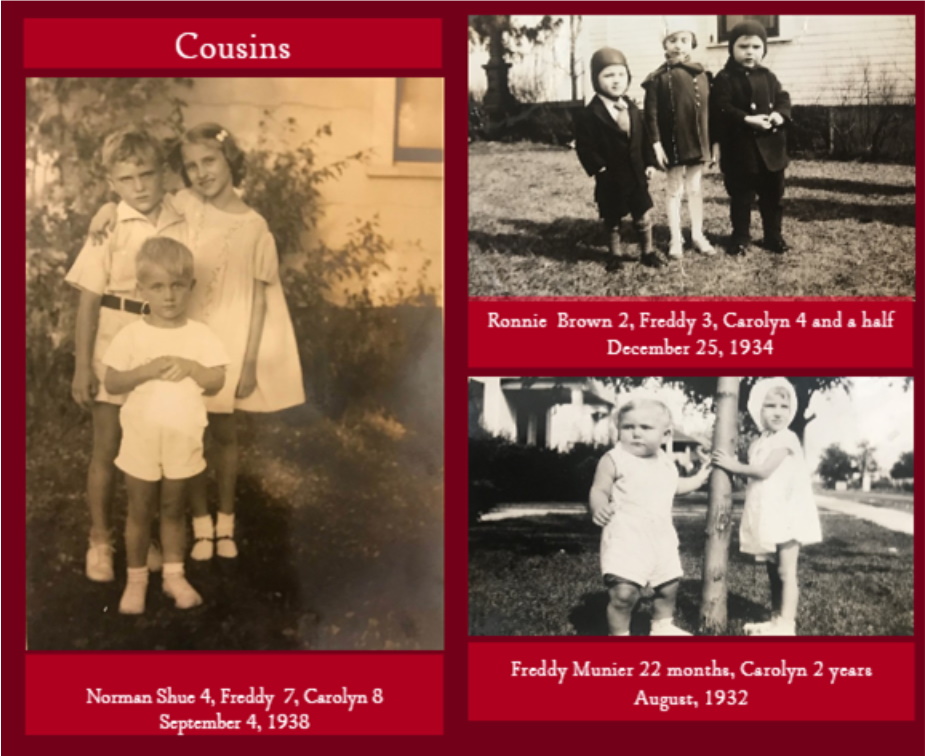
In the Spring of 1939, Carolyn was nine years old. She, her cousin Freddy, who was a year younger, and cousin Ronnie who lived on the farm next door was seven. As the cherries became ripe they spent their days climbing cherry trees and picking cherries. Meanwhile, Carolyn’s mother Ruth, Aunt Gladys and Aunt Evelyn, and Grandmother Brown worked in the kitchen making Cherry pies. Grandmother Brown used a huge old wood burning stove for all her cooking. Underneath the window, at 90 degrees to the stove sat a solid chest with thick oak boards was filled with firewood. The oak chest was made from an oak tree felled on the farm.
The cousins picked cherries although the picking was not fun, picking the cherries. By the time they were finished picking cherries, the first pies were done. Carolyn, Freddy, and Ronnie sat on the back-porch steps and ate fresh cherry pies with the fruits of their labor.