In 1969, Marianne Kruse and Carolyn Ruth Hunt were privileged to be part of an Educational Seminar tour of the Soviet Union, getting special meetings with school personnel; a Communist ‘Comsomol’ Pioneer Camp; the Minister of Education in Moscow ( A graduate of the Univ of Denver!), and other meetings in Kiev and Leningrad. We each armed ourselves with a new top of the line Nikon camera and lenses, and took about 1,000 pics each. Back home, we then exchanged at least 200 of our best shots. How do you boil 1200+ pictures down to a 12 month calendar?? The result is a Supplement of an extra 20 prints which help round out the story of our trip and its goals. They fall neatly into 5 groups: Everyday Life; the Ubiquitous Lenin substituting for God; Cathedral Square in the Kremlin; Moscow Subway; and The Arts – Odessa Opera House.
In 2009, we both wanted to do a 40 year anniversary calendar of this memorable trip. But “life” happened to both of us, postponing the event. We are happy we could make it happen this year, and hope you will enjoy with us our memorable, once in a lifetime tour of Soviet Russia in July, 1969.
Especially memorable was being free, apart from the tour, on the streets of Moscow on July 20, the day our astronauts landed on the moon. At the Chekhov Museum, we became the attraction to the Russian visitors; they all wanted to know about the moon landing and were as happy about it and anxious for its success as any American. They told us: “We are with you in our hearts!!” I (Carolyn) still get teary eyed when I think of that moment – one of the true highlights of my entire life.
EVERYDAY LIFE IN RUSSIA:
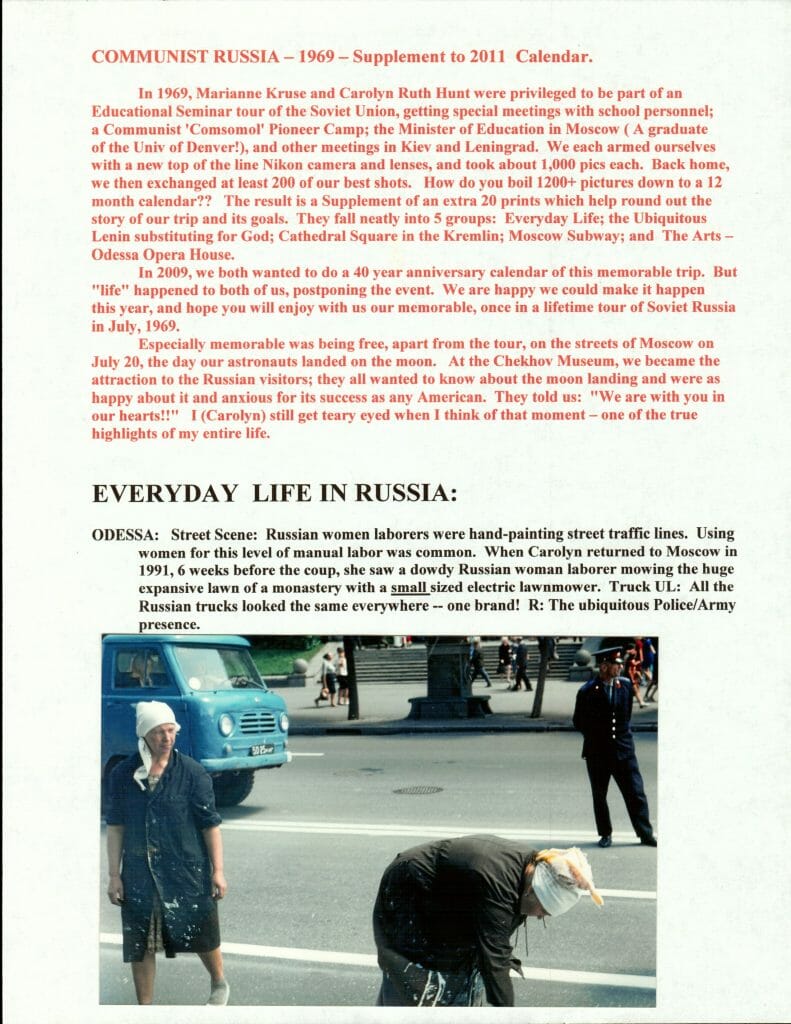
ODESSA: Street Scene: Russian women laborers were hand-painting street traffic lines. Using women for this level of manual labor was common. When Carolyn returned to Moscow in 1991, 6 weeks before the coup, she saw a dowdy Russian woman laborer mowing the huge expansive lawn of a monastery with a small sized electric lawnmower. Truck UL: All the Russian trucks looked the same everywhere — one brand! R: The ubiquitous Police/Army presence.
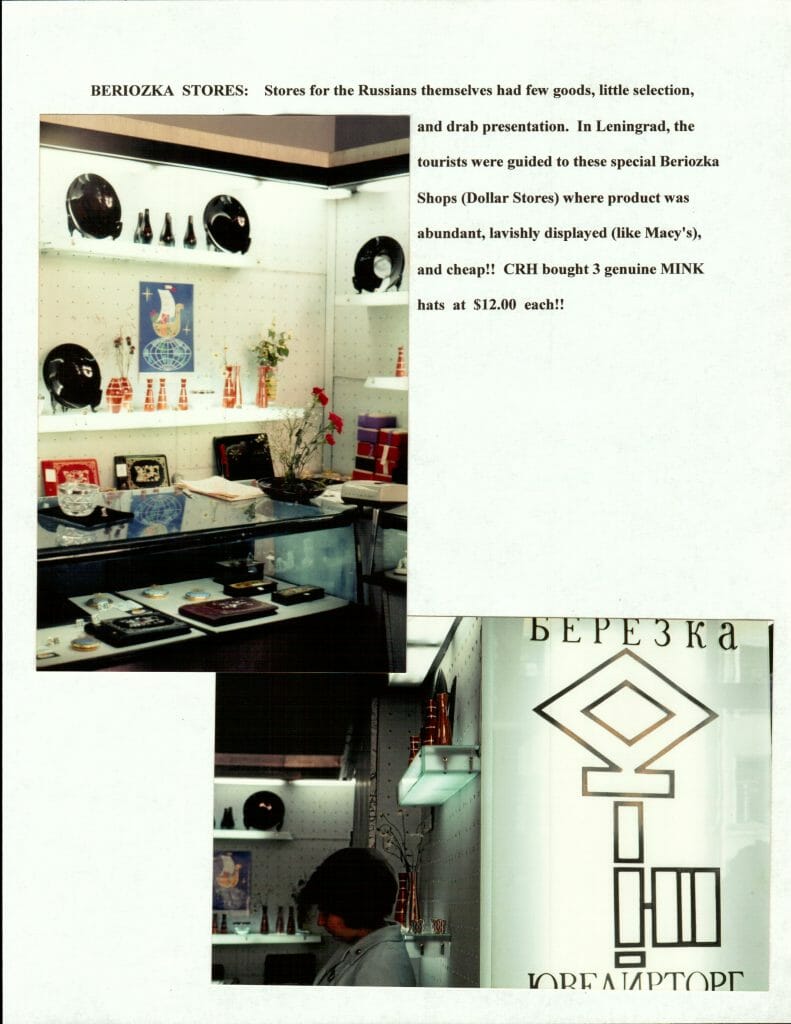
BERIOZKA STORES: Stores for the Russians themselves had few goods, little selection, and drab presentation. In Leningrad, thetourists were guided to these special Beriozka Shops (Dollar Stores) where product was abundant, lavishly displayed (like Macy’s), and cheap!! CRH bought 3 genuine MINK hats at $12.00 each!!
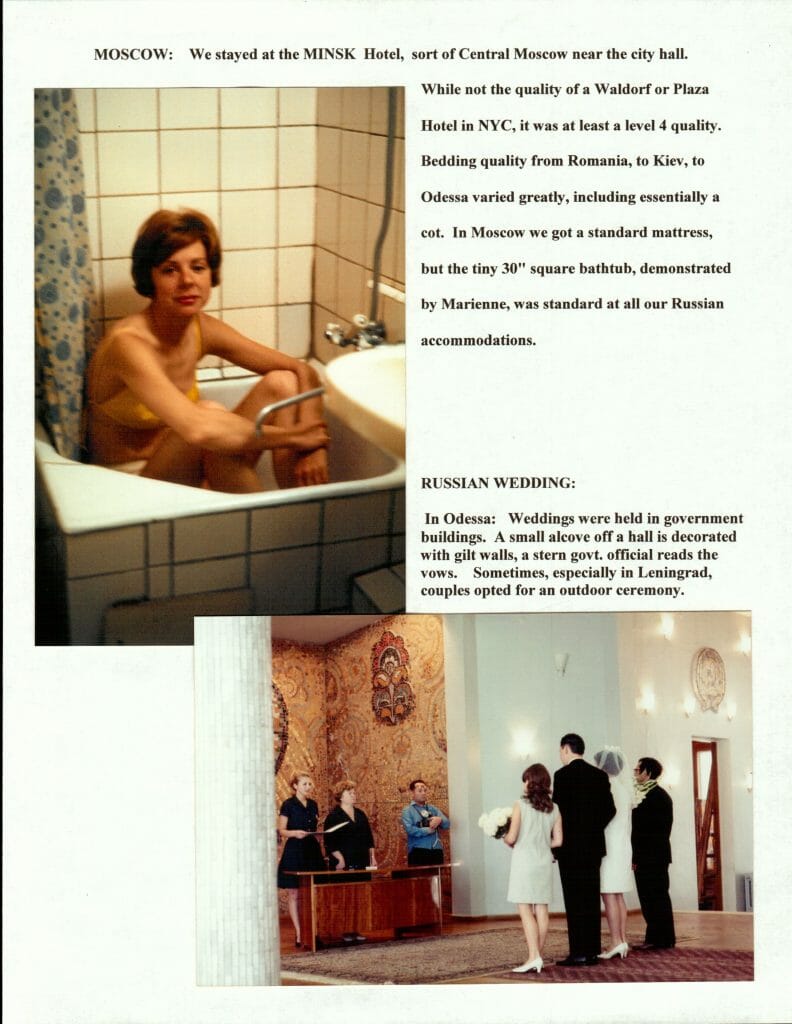
MOSCOW: We stayed at the MINSK Hotel, sort of Central Moscow near the city hall. While not the quality of a Waldorf or Plaza Hotel in NYC, it was at least a level 4 quality. Bedding quality from Romania, to Kiev, to Odessa varied greatly, including essentially a cot. In Moscow we got a standard mattress, but the tiny 30″ square bathtub, demonstrated by Marienne, was standard at all our Russian accommodations.
RUSSIAN WEDDING: In Odessa: Weddings were held in government buildings. A small alcove off a hall is decorated with gilt walls, a stern govt. official reads the vows. Sometimes, especially in Leningrad, couples opted for an outdoor ceremony.
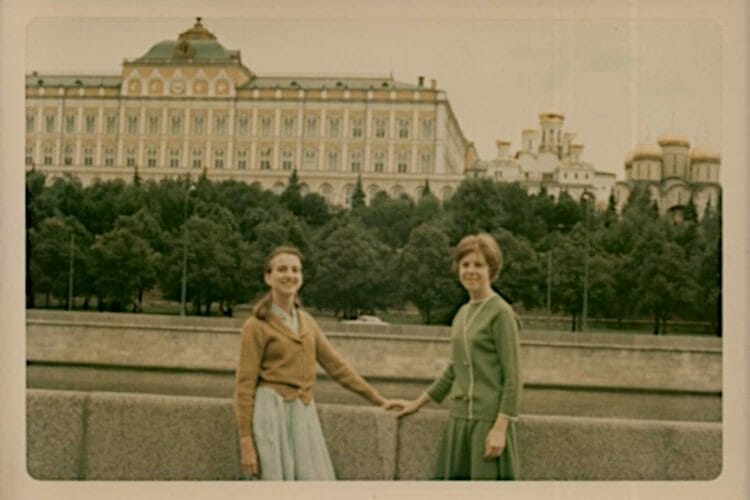
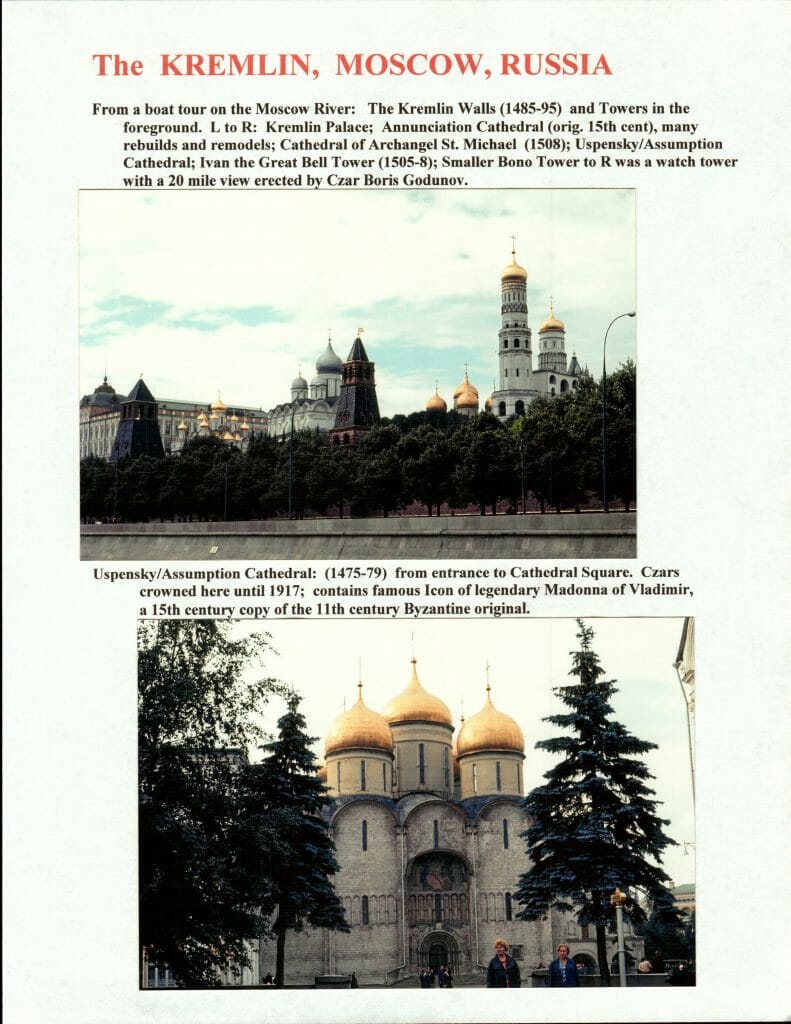
The KREMLIN, MOSCOW, RUSSIA From a boat tour on the Moscow River: The Kremlin Walls (1485-95) and Towers in the foreground. L to R: Kremlin Palace; Annunciation Cathedral (orig. 15th cent), many rebuilds and remodels; Cathedral of Archangel St. Michael (1508); Uspensky/Assumption Cathedral; Ivan the Great Bell Tower (1505-8); Smaller Bono Tower to R was a watch tower with a 20 mile view erected by Czar Boris Godunov.
Uspensky/Assumption Cathedral: (1475-79) from entrance to Cathedral Square. Czars crowned here until 1917; contains famous Icon of legendary Madonna of Vladimir, a 15th century copy of the 11th century Byzantine original.
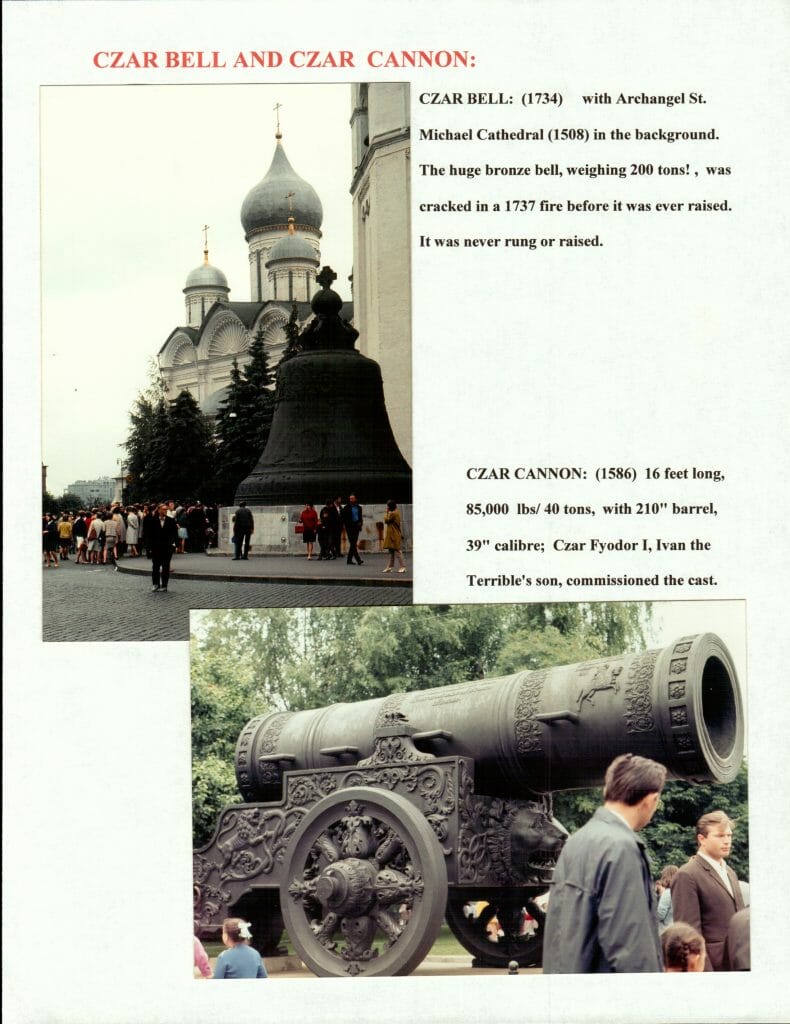
CZAR BELL AND CZAR CANNON: CZAR BELL: (1734) with Archangel St. Michael Cathedral (1508) in the background. The huge bronze bell, weighing 200 tons! , was cracked in a 1737 fire before it was ever raised. It was never rung or raised.
CZAR CANNON: (1586) 16 feet long, 85,000 lbs/ 40 tons, with 210″ barrel, 39″ calibre; Czar Fyodor I, Ivan the Terrible’s son, commissioned the cast.
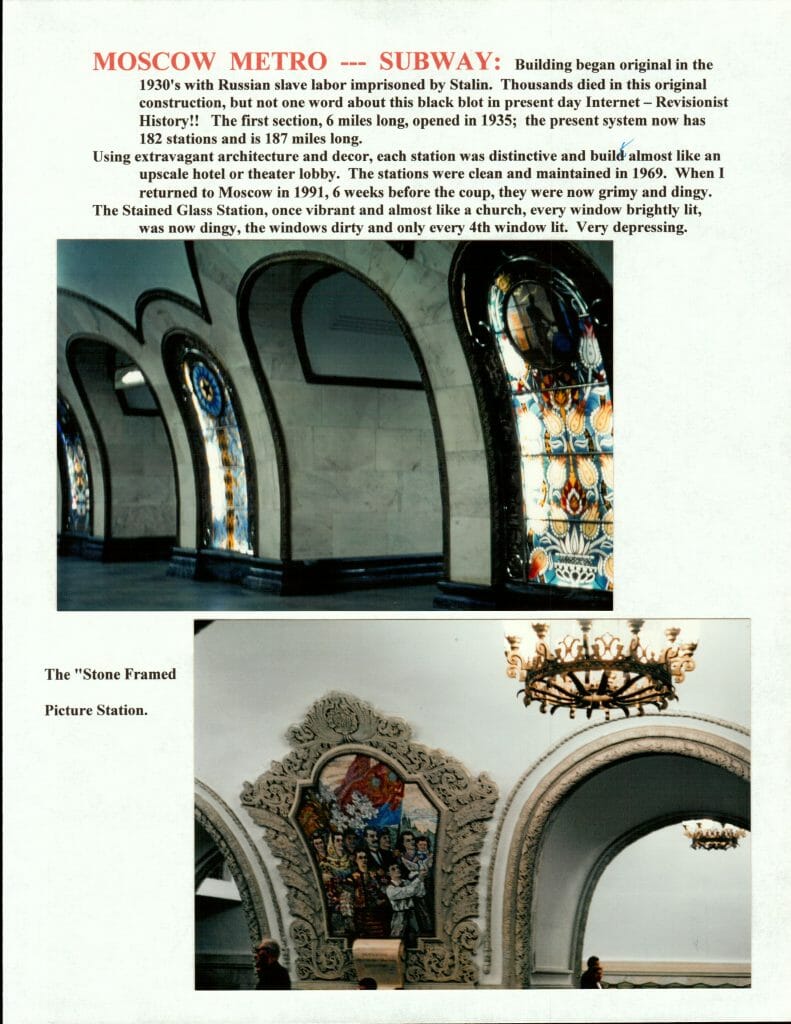
MOSCOW METRO — SUBWAY: Building began original in the 1930’s with Russian slave labor imprisoned by Stalin. Thousands died in this original construction, but not one word about this black blot in present day Internet – Revisionist History!! The first section, 6 miles long, opened in 1935; the present system now has 182 stations and is 187 miles long.
Using extravagant architecture and decor, each station was distinctive and build almost like an upscale hotel or theater lobby. The stations were clean and maintained in 1969. When I returned to Moscow in 1991, 6 weeks before the coup, they were now grimy and dingy.
The Stained Glass Station, once vibrant and almost like a church, every window brightly lit, was now dingy, the windows dirty and only every 4th window lit. Very depressing.
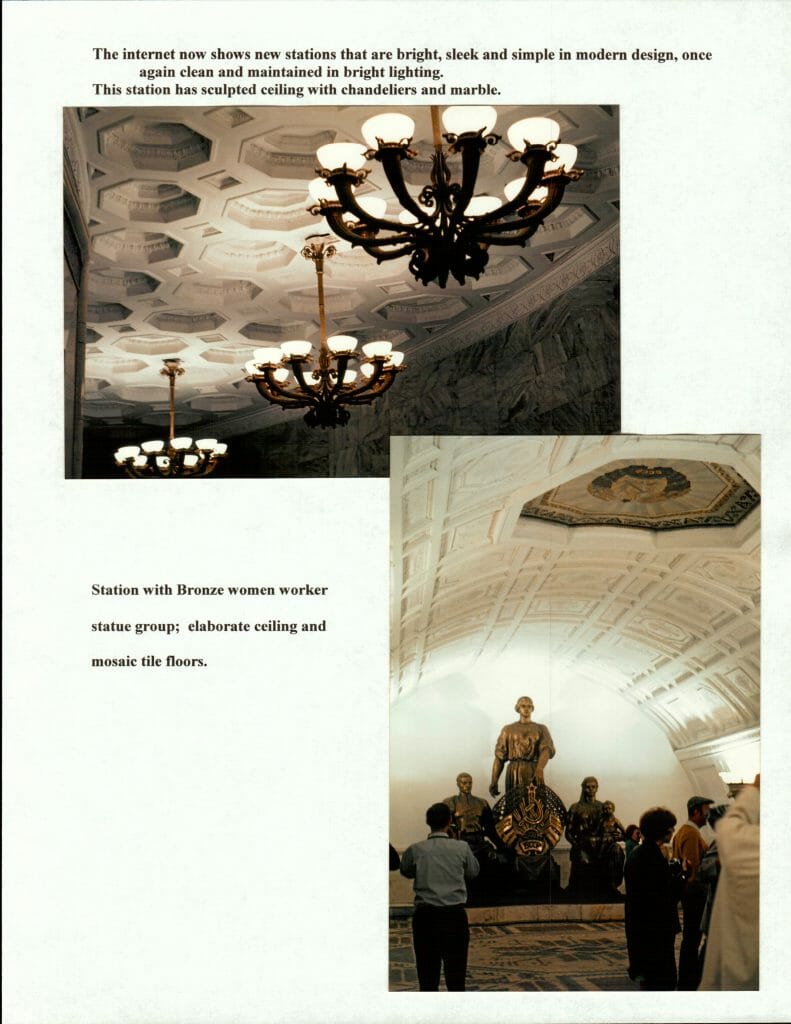
The “Stone Framed Picture Station. The internet now shows new stations that are bright, sleek and simple in modern design, once again clean and maintained in bright lighting. This station has sculpted ceiling with chandeliers and marble. Station with Bronze women worker statue group; elaborate ceiling and mosaic tile floors.
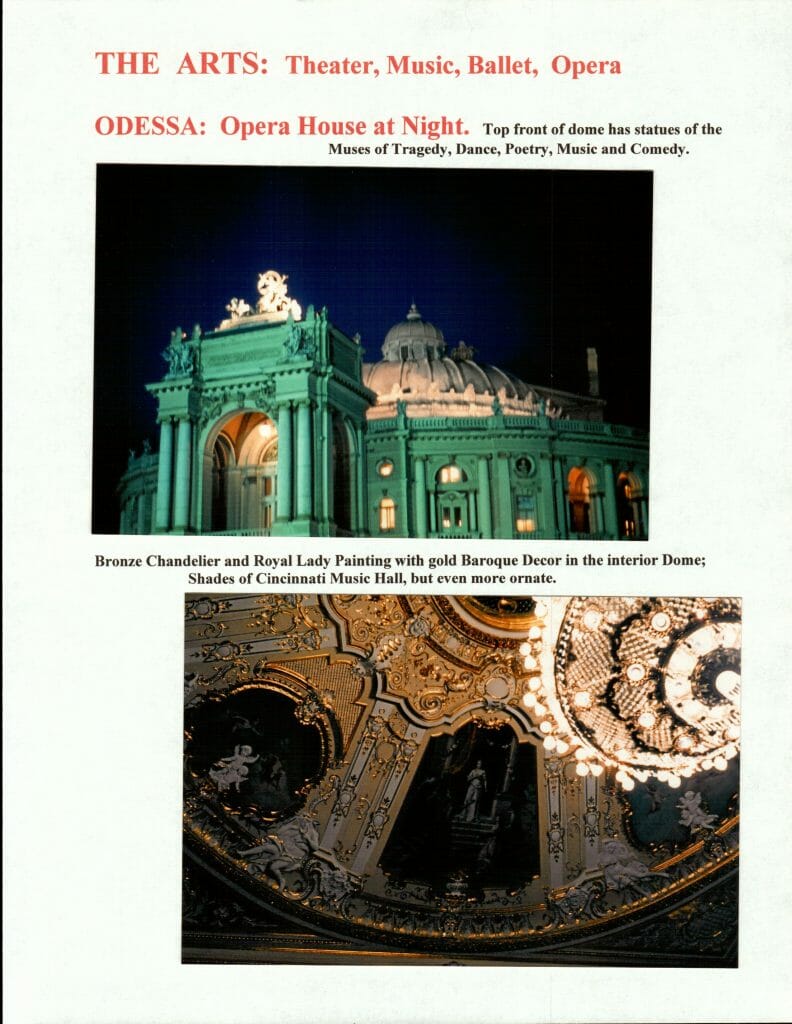
THE ARTS: Theater, Music, Ballet, Opera ODESSA: Opera House at Night. Top front of dome has statues of the Muses of Tragedy, Dance, Poetry, Music and Comedy.
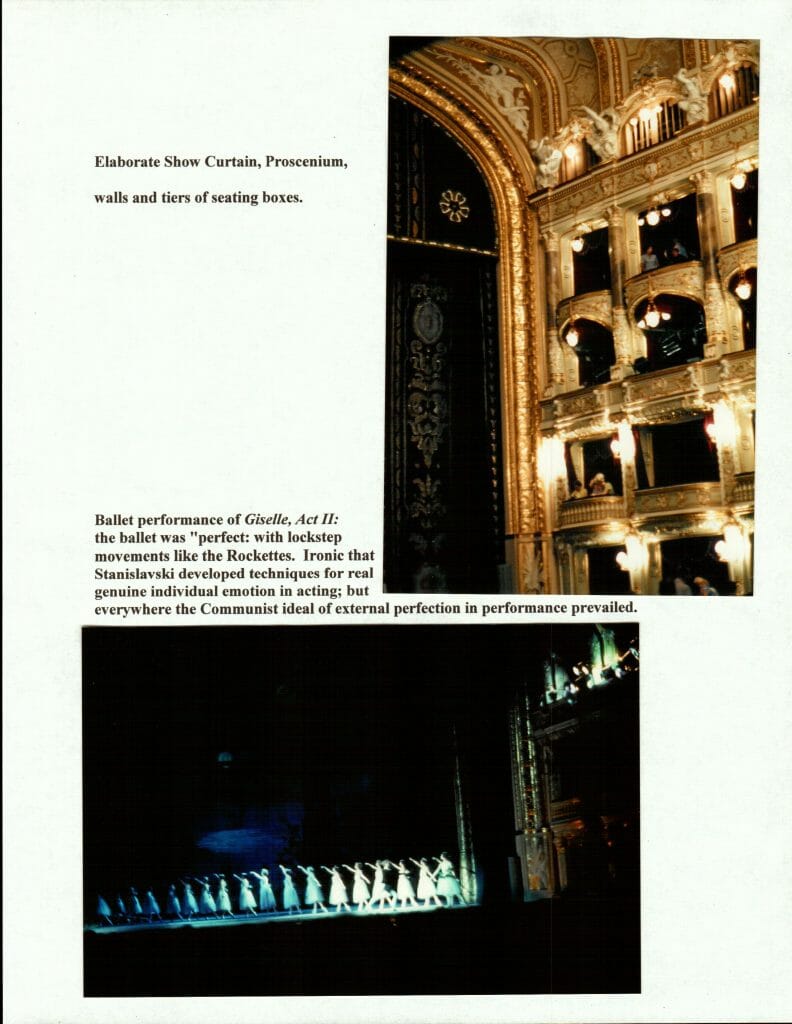
Bronze Chandelier and Royal Lady Painting with gold Baroque Decor in the interior Dome; Shades of Cincinnati Music Hall, but even more ornate. Elaborate Show Curtain, Proscenium, walls and tiers of seating boxes.
Ballet performance of Giselle, Act II: the ballet was “perfect: with lockstep movements like the Rockettes. Ironic that Stanislavski developed techniques for real genuine individual emotion in acting; but everywhere the Communist ideal of external perfection in performance prevailed.
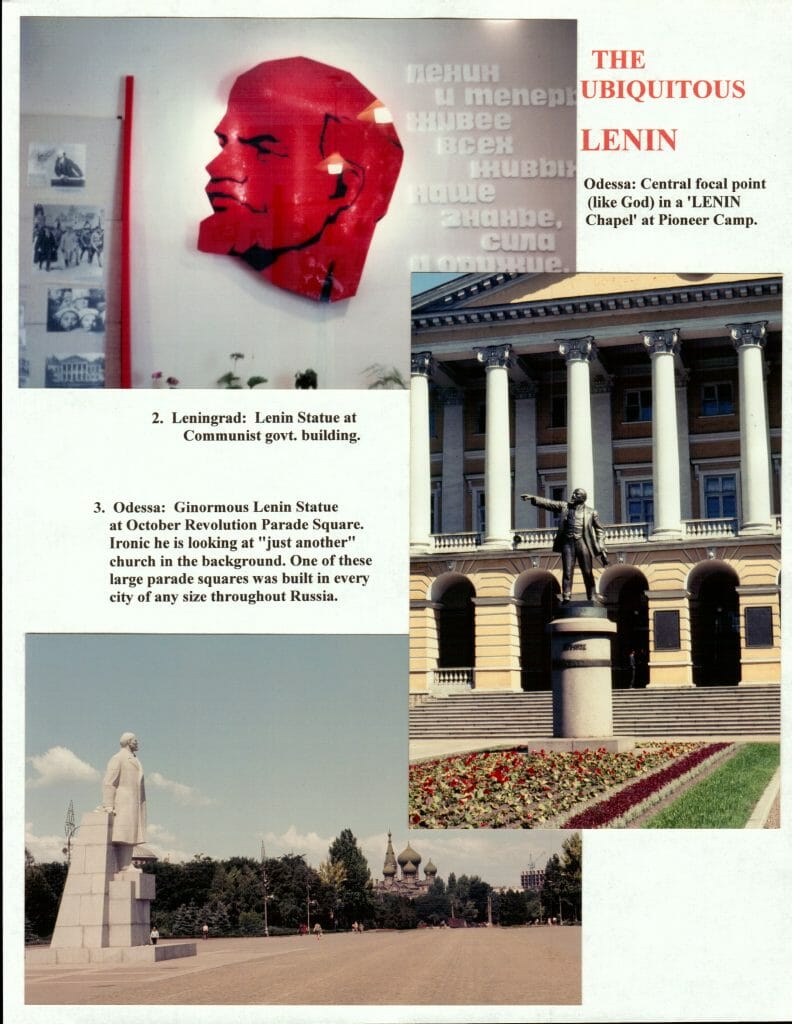
THE UBIQUITOUS LENIN Odessa: Central focal point (like God) in a ‘LENIN Chapel’ at Pioneer Camp.
2. Leningrad: Lenin Statue at Communist govt. building.
3. Odessa: Ginormous Lenin Statue at October Revolution Parade Square. Ironic he is looking at “just another” church in the background. One of these large parade squares was built in every city of any size throughout Russia.