
First, I was conceived in Dayton, Oh and born on July 29, 1930 in Pittsburgh, Pennsylvania.
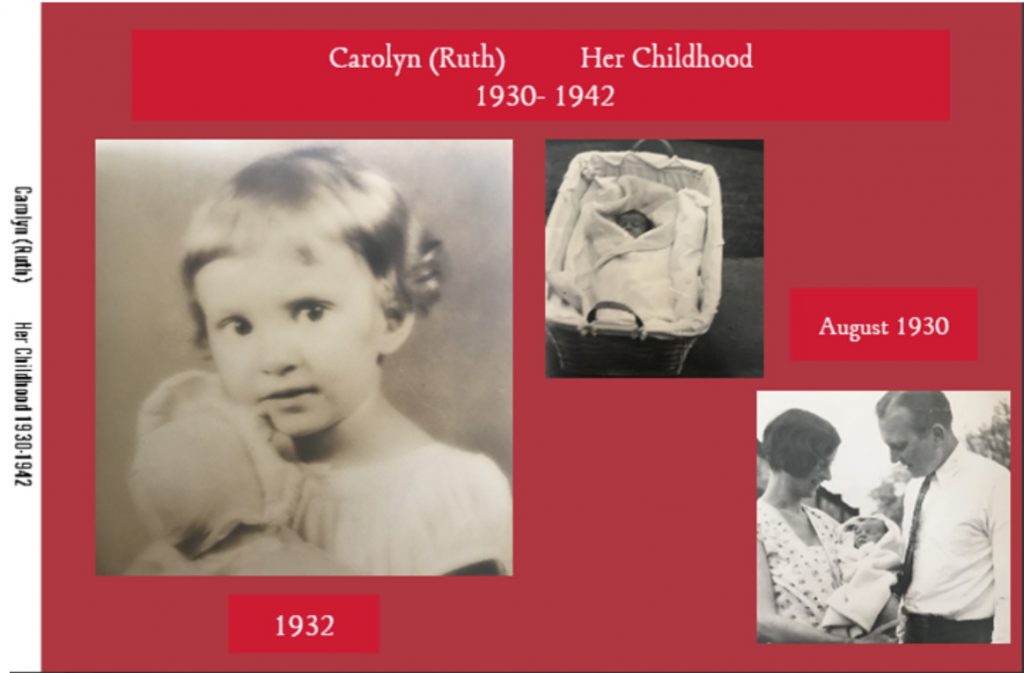
July 29, 1930 – 1933, Pittsburgh, PA, Mother and Dad lived in 3 different houses during these 3 years.
1933 – March 1937, 1183 Bridge Ave, Charleston, WV. I lived here during the January 1937 Flood. The river came up to 2 feet below the street level for downtown.
March 1937 – Spring 1938, 4th Street & 10th Avenue, Huntington, WV. The entire basement of the house we rented had been hit by the January Flood. I had my first group of really good friends when I lived here.
1937 – Winter 1938, Marshall College Preparatory School
Spring 1938 – Fall 1939, Circle Rd,,Charleston, WV, Fernbank Elementary School
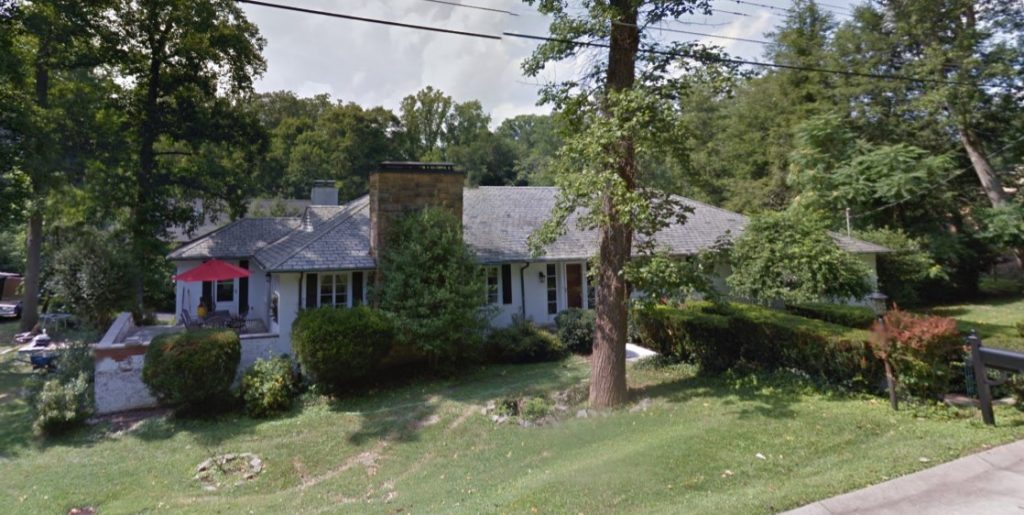
Fall 1939 – March 1942, 939 Ridgeway Rd, Charleston, WV in a much nicer house that was closer to my school so that I could walk to Fernbank Elementary school. This is where I lived when the Japanese attacked Pearl Harbor
March 1942 – Fall 1942, 4th Street & 11th Avenue, Huntington, WV.
Fall 1942 – 1948, 109 1/2 Maryland Ave, Charleston, WV, Lincoln Junior High School, Grades 7 – 9. Stonewall Jackson High School, Grades 10-12.
Summer 1948, I was secretary for Herbert G. Tog at the Office of the Director of Curriculum, Kanawha County Schools, Charleston, WW
Fall 1948 – Jan 1951, Marshall College, College Hall Dormitory (Freshman, Sophomore, 1st semester Junior)
Jan 1951 – May 1952, Alpha Xi Delta Sorority House of Marshall College, Huntington, WV. I graduated from Marshall College with a Bachelor’s of Arts degree with majors in Speech & Drama and Sociology and minors in English & Psychology.
May 1952 – June 1955, Chestnut Street, Parkersburg, WV with my parents (The Lost Years) I had jobs at Midway Loan Company then in 1953 – May 1955 Metropolitan Life Insurance. I also volunteered at the Methodist Church conducting the Children’s Choir. I spent summers playing Tennis and was the Women’s City Champion runner-up.
Summer 1954, My first tour in New York City.
Summer 1955, RA Willard Hall, Evanston, IL, Northwestern University for Masters Degree Oral Interpretation of Literature, Taught at the National High School Institute,
Fall 1955 – June 1956, RA Willard Hall, Evanston, IL, Northwestern University for Masters Degree Oral Interpretation of Literature with a minor in Speech Education. Received Masters Degree June 1956.
Summer 1956, Apartment, Evanston, IL, Northwestern University for PhD in Theater, Taught at the National High School Institute
September 1956 – Spring 1957, 2 1/2 room apartment in Spartanburg, SC where I bought my first pieces of furniture, a bed and a marble top table. I worked at Converse College, Assistant Professor & Chairman of the Speech & Drama Department where I met Tad Currie at when he was hired to work as part of the Speech & Theater Department in 1957.
Summer 1957, Evanston, IL, Northwestern University for PhD in Theater, Backstage Jobs at the Northwestern Summer Theater, esp. costuming, Taught at the National High School Institute. Met John Keltner who recruited me to work at Kansas State University where I would make $1,000 more per year
Fall 1957-Spring 1958, Manhattan, KS, Teaching @ Kansas State University, Oral Interpretation & Public Speaking, Chief Stage Costumer for the Plays. Hired by John Kelter.
Summer 1958, Evanston, IL, Northwestern University for PhD, Backstage Jobs at the Northwestern Summer Theater, esp. costuming, Taught at the National High School Institute.
Fall 1958 – Spring 1959, Manhattan, KS, Teaching Kansas State University, Oral Interpretation & Public Speaking, Chief Stage Costumer for the Plays
Summer 1959, Evanston, IL, Northwestern University for PhD, Backstage Jobs at the Northwestern Summer Theater, esp. costuming, Taught at the National High School Institute.
Sept 1959 – May 1962, Saratoga Springs, NY. I shared the downstairs of a very fashionable, beautiful old summerhouse mansion with a roommate. The mansions was a vacation homes owned by wealthy people from NYC. I was teaching Oral Interpretation, Theater, and was the costume designer at Skidmore College. The campus was spread throughout approximately 80 buildings in downtown Saratoga Springs. In 1960 Mother & Dad moved to Oakview Dr, Kettering (Dayton), OH.
Summer 1960, I spent in Colon, Michigan where I partnered with Tad Curry and two others and leased the Wingspread Summer Theater. I was also the Business Manager of our theater production company. We produced and staged 10 shows in 10 weeks, including Summer & Smoke, when I played the lead, Alma, for the first time.
May 1962, Cincinnati, Ohio on Whitfield Ave.
June 1964 – ~ August 1965, Cincinnati, Ohio on Ormond Ave across the street from Babette and Sigmund. I had the 2nd and 3rd floor of this house. The first summer I was there, I removed the paint from the woodwork. I sub-let the 3rd floor to Jinny Weil, that’s when I met her. Before I left for a tour of Europe with Tom Grooms, I told my landlord that I had heard rumors that they were going to sell the house and I wanted to make sure that I was going to have a place to live when I got back. She said, “oh, no! I’m not selling” but when I got back the house had been sold and I and my new roommate had 30 days to find a new place to live.
August 1965 – May 1, 1966, Cincinnati, Ohio on Orland Ave. I
May 1, 1966 – January 2016, Cincinnati, Ohio 3204 Coral Park Drive. I was tired of moving, so I decided I was going to buy a house. So dad did some searching and he’d come down and we’d go look at houses together. He found me the house. They wanted 26,000 for the house. It was a depressed market and dad was good at negotiation and he got them down to 19,000. I closed on the house in the spring and started moving in May 1. I lived there for 50 years.
January 2016 – January 2019, 5131 South Ridge Dr, Cincinnati, Ohio in my Patio Home at Twin Towers. I really enjoyed my Patio Home. I wish I could have stayed there longer. Jinny Weil, my friend from TDW and who lived with me for a short time on Ormand Avenue, lived across the street from me.
January 2019 . . . 5343 Hamilton Ave Cincinnati, Ohio. After 4 days in the hospital and 3 months in Twin Towers Rehab, it was time to move into Twin Towers Skilled Nursing.

Carolyn was two and a half years old when she, Mother and Dad went to the Kaufman’s Department Store in Pittsburgh to go shopping. The ten-story building loomed over her at the intersection of Fifth Avenue and Smithfield Street. Carolyn clung to her mother’s hand as she navigated through the crowd to the entrance.
Men and women bustled around the store like army ants- each person dedicating to completing their own tasks. Although shopping with her mother and father was boring, Carolyn loved the escalators. Abe and Ruth trusted Carolyn enough to turn her loose while they did their shopping. Soon they disappeared into the crowd of bodies, leaving Carolyn at the newly installed escalators with strict instructions. Her small hands skimmed along the smooth wooden railings as the moving steps boosted her to the next floor up. Giddy, she got lost in joy of riding the escalators up and down, and up and down. Each time was just as exciting as the last. But then Mother and Dad came back.
Dad walked towards Carolyn and said, “Okay, we’re going home.” Carolyn protested, “No! I don’t want to!” Carolyn threw herself onto the dirty department store floor onto her stomach-her tantrum making quite a scene. She cried and screamed, pounding her fists onto the floor. She did not want to leave, and made sure everyone knew it. Passersby stared in disapproval. Immediately, her dad picked her up and placed Carolyn over his knee. He began to spank her, right there in the middle of the department store, which is not something that would be permissible today. Blurry from the swell of tears, her fake cries changed tenor and never again did Carolyn throw another tantrum.
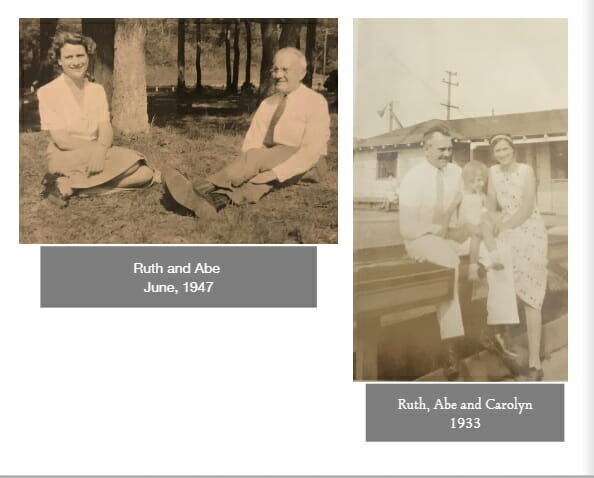
Carolyn’s childhood was filled with change. From birth to age twelve she moved nine times from Pittsburgh, PA to between Charleston, WV and Huntington, WV, living in nine different houses. This was challenging for Carolyn, the moving meant constantly making new friends. However, looking back Carolyn believes that this change was for the best. She was fortunate enough to have a stable home, where her mother and father were always a strong guiding education force and although the change was difficult, she values the experiences and varied adventures she had. Moving schools allowed her to interact with different people and learn how to make friends. She spent much of her time with her mother and with her father at home. They played games together, like Parcheesi, Chinese Checkers, Sorry and Monopoly. She enjoyed solitary projects like coloring books, playing with dolls, and playing with cut out dolls. Her favorite dolls were the Dy-Dee doll which you could feed a bottle and a Snow White doll she got at seven years old. Carolyn and her mother would go to the store to buy fabric and look at pattern books and deciding what clothes she wanted. Her mother was a professional grade seamstress and made all of Carolyn’s dresses and dance costumes. At four years old she idolized Shirley Temple and at age seven she admired the singers Jeanette MacDonald and Nelson Eddie. Despite moving, her mother sought to add some normalcy to her daughter’s life by encouraging her to take dance lessons.
With each move, Mother brought two brass candle sticks, a green fruit bowl, and a brass candelabra, which were fixated on the mantle of every house. This was a source of comfort for Carolyn through the moves.
The first time Carolyn and her parents moved to Charleston, WVa. they moved into a large beautiful house up in South Hills on Bridge Road. The house was near the top of the hill. It had eight large rooms and a huge full basement, with a steeply inclined driveway that ended at the bottom twenty feet from a wall with an abrupt ten foot drop off to a deep ravine and stream running below. From the driveway ran a path, which and wound up and over away from the back of the house and into the woods to a small cabin, where a little black girl lived, with whom Carolyn became friends with in 1933. The girls played many games together, just as children do, and it was this experience that planted in Carolyn the seeds of acceptance activism. Throughout her teen years, she spent much time working with the Methodist Church to try to integrate churches.
In 1937, Carolyn moved to Huntington for the first time and lived on West Forth Street. She was thrilled to find neighborhood girlfriends to play with. In March of 1937, Carolyn met her group of friends, neighbor girls around her age with whom she became very close. Claire Sue was Carolyn’s best friend who lived 5 doors down and Jacqueline lived in between. Martha Jane, who went by Cherry, was the youngest of the girls and she lived on the street behind Carolyn on West Fifth.
Carolyn grew up with very few playmates, and as mentioned before was very grown-up for her age. Her father was an intellectual man- a former school teacher and superintendent. Carolyn ’s childhood was filled with educational trips and experiences such as going to the San Francisco World Fair and tooling around National Parks along the way. Upon meeting Cherry for the first time, Carolyn exclaimed, “Oh, you’re Cherry, I presume.” The other girls were stunned, looking at her as if she had six heads, because it was surprising to hear a seven-year-old speak with such big words. Despite Carolyn having a more adult vocabulary than the other girls, they all got along well, and Carolyn was finally able to feel like a normal girl.
The first time Carolyn and her parents moved to Charleston, WVa. they moved into a large beautiful house up in South Hills on Bridge Road. The house was near the top of the hill. It had eight large rooms and a huge full basement, with a steeply inclined driveway that ended at the bottom twenty feet from a wall with an abrupt ten foot drop off to a deep ravine and stream running below. From the driveway ran a path, which and wound up and over away from the back of the house and into the woods to a small cabin, where a little black girl lived, with whom Carolyn became friends with in 1933. The girls played many games together, just as children do, and it was this experience that planted in Carolyn the seeds of acceptance activism. Throughout her teen years, she spent much time working with the Methodist Church to try to integrate churches.
In 1937, Carolyn moved to Huntington for the first time and lived on West Forth Street. She was thrilled to find neighborhood girlfriends to play with. In March of 1937, Carolyn met her group of friends, neighbor girls around her age with whom she became very close. Claire Sue was Carolyn’s best friend who lived 5 doors down and Jacqueline lived in between. Martha Jane, who went by Cherry, was the youngest of the girls and she lived on the street behind Carolyn on West Fifth.

Carolyn grew up with very few playmates, and as mentioned before was very grown-up for her age. Her father was an intellectual man- a former school teacher and superintendent. Carolyn ’s childhood was filled with educational trips and experiences such as going to the San Francisco World Fair and tooling around National Parks along the way. Upon meeting Cherry for the first time, Carolyn exclaimed, “Oh, you’re Cherry, I presume.” The other girls were stunned, looking at her as if she had six heads, because it was surprising to hear a seven-year-old speak with such big words. Despite Carolyn having a more adult vocabulary than the other girls, they all got along well, and Carolyn was finally able to feel like a normal girl.
In 1933, Mother and Dad went to the Chicago World’s Fair for a few days. It was the first time they left Carolyn alone with Grandmother and Granddaddy Brown at the farm. A visit to the farm happened every summer, for two weeks or more. Granddaddy owned several hundred acres of land and two barns. The first barn contained the pig pens and was where they slaughtered pigs each year. There were many acres of tobacco and corn were grown. The tobacco was stripped in the barn and hung from the rafters to cure. The second barn was a bit more appealing as it held one tractor and all of its attachments, Cows and horses. . Granddaddy owned around eight cows and every morning and evening he milked them. He brought the cows into the stalls which smelled of fresh hay and tied them up to be milked. Granddaddy grabbed the milk stools and taught Carolyn from a her young age how to milk a cow. By the time Carolyn was about six or seven years old, she could milk a cow on her own. Prior to those years, her hands were too small and too weak. One thing Carolyn loved most about milking was being able to drink warm fresh milk straight from the cow’s utter. To this day, she cannot drink plain white milk because it pales in comparison to the delicious unpasteurized goodness of the warm creamy milk from the utter.
In the stables, the drinking troughs were eight by three feet; the horses and cows shared them. When Carolyn grew up, the hen house was the original farm house. Carolyn often went in to collect what now would be considered free range eggs. For their chicken dinners, Grandmother went down to the hen house and chose a chicken. On the back walkway of the house, she twisted off its head allowing it to flop around on the sidewalk. When the chicken stopped moving, she put it in scalding hot water, plucked the feathers, and brought it inside to cook, a process Carolyn would not soon forget.

In the Spring of 1939, Carolyn was nine years old. She, her cousin Freddy, who was a year younger, and cousin Ronnie who lived on the farm next door was seven. As the cherries became ripe they spent their days climbing cherry trees and picking cherries. Meanwhile, Carolyn’s mother Ruth, Aunt Gladys and Aunt Evelyn, and Grandmother Brown worked in the kitchen making Cherry pies. Grandmother Brown used a huge old wood burning stove for all her cooking. Underneath the window, at 90 degrees to the stove sat a solid chest with thick oak boards was filled with firewood. The oak chest was made from an oak tree felled on the farm.
The cousins picked cherries although the picking was not fun, picking the cherries. By the time they were finished picking cherries, the first pies were done. Carolyn, Freddy, and Ronnie sat on the back-porch steps and ate fresh cherry pies with the fruits of their labor.
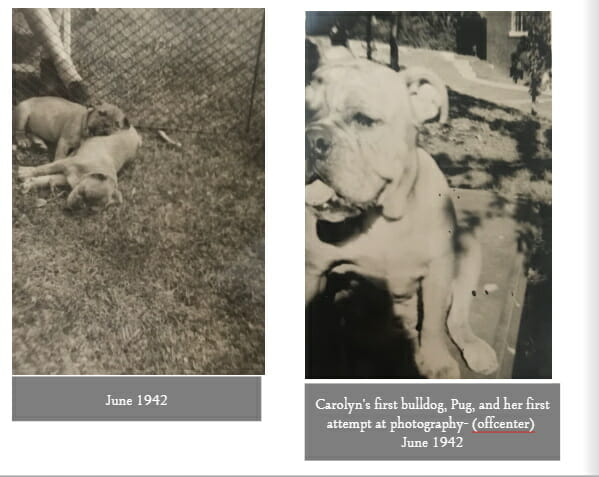


It was August of 1936, a month before Carolyn was to start school. The air was cool against her cheeks, and the ground was wet after a big rain. Following the storm Carolyn asked to scooter on the front walk. From the main road, her house sunk into a ravine. She started her ride on the walkway at the stairs which came down from the street. The walkway curved in an S shape, bending right and then left ending at the porch. As she rode her scooter down the walkway she picked up a lot of velocity and followed the S curve. Instead of crashing into the porch, she veered into the grass in the yard, so she could slow down enough until and hop off. Her super neat father had dug out a gulley and while veering into the grass, her wheel suddenly got twisted in the ditch between the side walk and the grass. Carolyn propelled in to the yard and as she fell she folded her elbow in and landed elbow first into the sod. Upon falling into the soft dirt, the bone in her left arm snapped, just above the joint in the forearm.

She screamed and yelled in pain. Her mother and her father came out to check what all the commotion was about. Her dad scooped her up into his arms and carried her to the car. Their house was located near the top of a hill and the roads were horrible- narrow and bumpy with not a lot of side rails. In the car, Carolyn held her arm in a V against her chest while her mother held her securely. Her father drove like a bat out of hell down the narrow winding road. The car sped down the road, lurching and bumping which strained poor Carolyn who was curled in her mother’s lap in agonizing pain. The South Side Bridge was closed for construction and they were forced to detour onto MacCorkle Avenue, a dirt road with only one strip of concrete down the middle, which made for very bumpy ride. Eventually they crossed the South East Bridge into downtown. Father drove towards a big dark red brick building, McMillan Hospital.
The building was basic and utilitarian four story brick building. Carolyn and her parents met her doctor and owner of the hospital, Dr. McMillan and the treatment of her arm began. Her arm was still incredibly swollen and painful as they went through the general procedure. Doctors and nurses shuffled Carolyn about, they took X rays and asked questions. It was so swollen that Dr. McMillan was not sure if he would be able to set it. Carolyn had to stay Monday through Wednesday for evaluation. Dr. McMillan finally told her parents, “The break is too close to the joint- I don’t think I can set this, so we may have to amputate the arm.” At that moment, Abe fell into a fit of rage, and almost tore up the hospital. He commanded to Dr. McMillan, “Absolutely not! You will not take off her arm. I don’t care if you bend it, so she can’t bend it for the rest of her life, you are not taking it off.” Dr. McMillan did the best that they could to reset it and as a result, Carolyn continues to have a fully functioning arm. Over the next 5-6 years, Carolyn’s X-rays and case became the subject of medical seminars and paper presentations at medical conventions for the correction of such an unusual break.
Carolyn was in a cast for six weeks after getting her arm set. She started school late, and registered for first grade on the last day possible, September 30th. When Carolyn was able to take off her cast, she had to do various exercises. There was not any physical therapy back then and the doctors gave her mother instructions as to how to care for and strengthen her arm. Carolyn was instructed to lie flat on a bed with an iron doorstop tied to her wrist. It was five inches long and an inch wide with a Bronco horse rearing back. She repeatedly curled her arm with this heavy iron doorstop tied to her wrist until she gained her strength back.
Highlights of the trip at 8 years old
In the 20s, Dad and Mother would take trips and go tent camping, imagine a Model-T type car and those 1920s roads. When they had a baby after 1930 (me) it was sort of restrictive because he was with GMAC and did a lot of driving to collect bills. So in 1938 he started driving around again. It was 1938 when we started taking road trips as a family. That’s how I started with all of my road trips.
In the summer of 1938, we started from home in Charleston WV. The roads were not that great. The car would have been a pretty nice one because dad worked for GMAC and got a discount. He tended to buy Buicks. In 1938 we would have been in a nice new car. (Aside: We had all of these nice cars up until the war. Then he bought a 1938 Chevrolet with a stick shift on the floor. This was the car I had to learn to drive with. An old used car instead of one of the nice ones we had before the war. )
In 1938 the roads were not that great. Some of them were nice enough, but some were just back-roads with one strip of concrete in the middle with gravel on each side, so you’d drive in the center on the pavement until another car came and you’d each ride on the gravel until you passed each other.
We went to Gauley Bridge, up the New River, up in the mountains, to New River Gorge (now a National Park) and looked down into the gorge, it was really spectacular.
From Beckley, we went over the mountains and went up Skyline Drive (what was open to the public at the time). We might have gone to the Greenbriar, because Dad had gone there for conferences before, but I don’t specifically remember.
Dad always assiduously avoided cities.
The next thing I remember, though not quite as clearly. I seems that we went to Gettysburg Battlefield in Pennsylvania. I know I’ve been to Gettysburg, and I don’t know when I would have done it if it wasn’t this trip.
The next thing I remember is being at a Howard Johnson’s in Connecticut. That was the big, quality hotel chain that we always aimed to stay at. Mom and dad decided that I could order my own lunch. I don’t know that I could read the menu that well, but I decided that I wanted a hotdog and sassafras tea.
The next thing I remember distinctly was going to Provincetown, Cape Cod and standing there and looking down at Plymouth Rock. I think it has carved 1620 into it.
We went to Boston and the North Church and Bunker Hill. After that, we went up into New Hampshire and saw the Old Man on the Mountain.
We may have gone to Saratoga Springs because Mother liked horses and would like to bet on them at the races.
We went from there across to Niagra Falls. I bought 2 necklaces that were made from the rock under the falls. The stones were pastel pink and about the size of my pinky nail. (One I gave one to Lauren and I don’t know where the other one went.
When we went from Niagra Falls we went though Pittsburgh and down the Ohio River, back home to Charleston WV.
Mother and Dad their best friends Norma & Benny Hutton and their daughter Patty went to Petoskey. We stayed in cabins on Lake Michigan. Patty and I went along the beach and picked up Petoskey Stones.
We didn’t have much sex education back then. Mother didn’t know quite how to explain it to me, so she gave me a book that I was supposed to read, which I did. I didn’t know what the hell I was reading. It was very detailed. I had never seen my father naked. When I was 7ish in the summer at Grandma’s farm, there was a 3-holer (a three hole outhouse). I remember when I and Freddy Munier who was one year younger and Ronny, who was a year younger. We all three ended up down at the bottom of the garden at the 3-holer and I guess we played “you show me yours and I’ll show you mine”. I guess that’s as much anatomy as I’ve ever seen.
My best guess is that I was 12 or 13 when I got this book. Sex back then was tee-hee! oh-no! and we were so innocent. I heard this on the TV in 1943, the movie The Outlaw was released, with Jane Russell. I can almost remember sitting in the movie theater, she had a long dress on, very low cut and she leaned over so that you could see her cleavage. Ooooohhh! Look at that. That was my sex education. It’s almost viceral, the memory of my response to it.
My father made sure I never saw him or You get shaped by your parents attitude toward sex, like a tape in your head. I can remember Norma and Benny Hutton, their best friend, would come down from Charleston, and they would all go down to the red light district and call the girls over to flirt with them, then Mom and Norma would pop up out of the back seat and laugh at them. I never did like that story. I didn’t know anything about sex, but I thought that it was a horrible thing to do to someone.
That was the sex education I had.
The Civil Rights movement was a collection of strong individuals working together to become a reckoning force. We didn’t have toys, you know, iPhones and stuff, but we had courageous people that would stand up to take charge. So whenever I could, from the time I was 12 with the liberal arm of the Methodist Church, St. Marks Methodist Church in Charleston, I became one of those individuals.
I met Bill Giles for the very first time on a fall weekend at a dance and mixer at Hodge’s Hall – the men’s dormitory at Marshall College. The mixer was for their freshman residents and I decided to go. He “picked me up” and walked me home afterwards. I’d find out that Bill was always good at picking up girls. That was one of his talents. In November of 1969, he told me he was attracted to my skinny ankles. I guess I owe my lifelong friendship with Bill Giles to my skinny ankles.
He was a great talker. He especially liked talking about Science and Music. I was in alpha z delta and we had the sorority and fraternity parties, but we didn’t like them so we would sit in the car outside the sorority house talking (and necking). I remember us having these long, long talks – sitting in the car – about how he hated the government, about how he hated school and the education system. Some afternoons, Bill and I and Bill’s best friend, Homer, and his date would take a picnic lunch and go to Ritter Park to our favorite spot and we’d talk some more. It’s pretty ironic that he would rail and rail on about the education system as he ended up getting his master’s degree (a lot of school) and later become a teacher (a lot more school). He did, though, take his son out of school as fast as he could. Bill would also attend the plays that Homer and I were in.
We dated. Not a lot, but we dated. We weren’t in Love. Bill was just one corner of my life at Marshall. I had a whole life in theater and school. A lot of school. In my junior year, when I met him, I was taking 22 hours. One semester in my senior year, I finally needed a break, and I took 12 hours. My 13th hour was playing bridge in the student union. I became a very good bridge player.
So, after many conversations about the future, I realized that Bill was a good friend, but I wanted a career. And he was never going to go anywhere in a career, as well as I could see. After college, I just let the relationship wither away.
I did though, go down to Marshall on their homecoming weekend in October1952 – in my brand new 1953 Chevrolet Bel Air – and we spent the weekend going to homecoming events together, to the dance and all of the activities. But by this time I already knew, because he had told me, that he had another girlfriend back home in Williamson, WV – Jenny – whom he’d eventually end up marrying.
And so began our life-long on-and-off unique relationship that lasted 59 years until the day he died at my house in April, 2009.
When I graduated from Marshall I wanted to move to Charleston, WV and get an apartment and a job and see what I wanted to do with my life. I had had enough of schooling and I needed to get out on my own. I had decided the year before that I was not going to have a career in the church and so I didn’t know what I wanted to do. I felt like I needed a “gap year” (or two, or three) to figure it out, but in 1952 there was no such thing as a “gap year”. My father said he would pay the whole ride for my masters degree – room, board, and tuition – if I would continue on with my schooling the year I graduated from Marshall. But, if you want to get a master’s degree, you first have to know what you want to do for a career.
But Daddy said that Good Girls don’t do that – move to the city. He was not going to let me go out in the world and that made me very angry. I was never rebellious. I was always a Good Girl. And he and Mother used everything in the book to convince me to stay at home. I reluctantly gave in and went back home to Parkersburg.
Daddy did all the woodworking to create a room for me in the attic of their house and I did the painting and got to choose the color. Our neighbor across the street, Mr. Montoya, came over when I started painting it and said “oh my god! Shit green!” I thought it was beautiful and sunny. I liked it! At that time, it was the only rebellion outlet I felt like I had.
So that summer of ’52 I started looking for a job, but college taught you how to be a newscaster, but they didn’t teach you how to get a job selling advertising to work your way up the ladder. And I wasn’t very good at interviewing. I never had the confidence. When I got in a structured group like the church, I had a lot of confidence. It always took me a while to get my sea legs. I interviewed at the radio stations and each time was a learning experience.
While I was looking for a job, I joined the Methodist church, sang in the choir, worked with the youth group, became the children’s choir director, and started playing tennis. The tennis courts were 3 or 4 blocks from the house, so I got dad’s old tennis racket and I played tennis every summer, 52-54 and got to be pretty good at it. Good enough so that by 1954 I entered the Parkersburg Women’s Championship and won runner up.
Everything I did that summer and beyond, I got older and wiser, but it still took me a long time to do everything.
So that fall I finally got a job at Midland Finance, a small loan company and I interviewed people that wanted to get a loan. I was there for about 4 months when Dad told me to go upstairs in his building to interview with Harriet Stalder at the Metropolitan Life Insurance Company. For a nice pay raise I went there to work as a clerk. The agents would be in one room with their cigars and their cigarettes and the smoke. Harriet Stalder and I had our own office and a window for the people coming up to pay their $5 a month or whatever they were paying so they have insurance. When I could, I’d go talk to the agents and try to find out all I could about selling insurance. When I suggested that maybe I could do it, they’d say, OH NO! Women can’t sell insurance! Well, Heaven forbid that a woman should sell insurance. There were a couple of other places too where I suggested that I could do something and OH! Women can’t do that! That’s what I encountered from 1952 to 1955 in getting jobs and teaching college. You really had to prove yourself. Well, I was kind of at the beginning of the feminist movement, and I said Hell Yes! Women can do that!
I worked at Met Life for three years – living in my parents attic, doing all of my activities with the church, and playing tennis – until I went back to college, to Northwestern University, to get my master’s degree.
In June of 1952, Mary Kay Kelso, Curtis Barber, John Bowyer, and I drove to Ames, Iowa for Bill Cox’ Graduation from divinity school and his wedding. We drove home by way of Chicago and went to a night club starring Jimmy Durante. Getting to go to a Chicago night club to see Jimmy Durante was a BIG DEAL.
1952 – Buying My First Car
As I was driving across the country I suddenly realized that I had driven miles and miles and no one had yelled at me about my driving. It was Curtis’ car and I asked him, “Am I driving okay?” And he said, “yeah, of course. Why are you asking?” And I said “I’ve been driving for miles and you haven’t made one comment about my driving.” He said “Why would I? It’s fine. You’re a good driver.” I realized then that I had always driven my father’s car with him in it and he always made comments and criticized my driving. I had been driving for 6 years and never knew I was a good driver. I was feeling little bits of rebellion again. It had never occurred to me to get my own car before because I could always use dad’s car and I didn’t know I was a good driver. So when Curtis told me I was a good driver, I decided then that I was going to get my own car. When I got home I told my father that I wanted to buy a car.
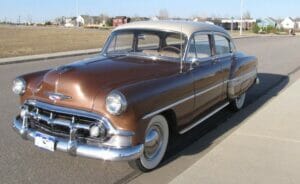
Of course Dad worked for GMAC so he got to buy the car with his employee discount and he chose the car for me. He got the loan for me, but it was in my name, and that helped me get credit. But I had to take the car he picked. Ugh! At 21! Anyway, he chose a brand new 1953 Chevrolet 4 door Belle Aire with a gorgeous, beautiful light beige top and dark brown bottom. But it was MY car and it was brand new, so I didn’t complain about the color. I was happy to get back and forth to work on my own and be independent.
1953 – College Hall Crowd Reunion*
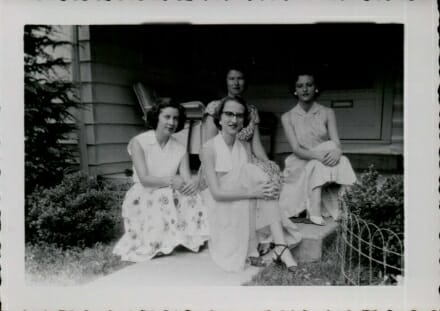
The girls had been teaching for a year, they all had cars and they drove down to my house in Parkersburg. They visited for the weekend. In the fall of 52 I had the homecoming activities with Bill and the winter in Parkersburg was boring, but then we had the reunion.
Childrens Choir Director and that whole aspect of church life and I performed programs around the city and in the church where I sang folk songs with the autoharp as a community service. Oh Shenandoah, Down in the Valley, I loved playing it. I didn’t have a good ear, so I had to tune it to the piano all the time.
I indulged in during my three years in Parkersburg was playing tennis at the city park courts about 4 blocks from the house.
1954 – New York City
I knew by the middle of 1953-54, while I was living with my parents in Parkersburg, WV, that I was going to go to Northwestern University School of Speech. Since Dad was not going to pay for my Master’s Degree because I didn’t pursue it straight after Marshall, I had to save the money to go. So I saved up for Northwestern and at the same time, for a trip to New York City. I had always wanted to go to NYC for the theater, so in 1954 I went with a tour group to New York City for my fist time there. We went to all of the tourist stops in the city like the Empire State Building, the Statue of Liberty, and the Staten Island Ferry. We stayed at one of the tourist hotels Off-Broadway and we took double-decker bus tours uptown and downtown. And of course, we saw a couple of Broadway shows.
Re-meeting Bill Giles (November 1969)
Willard Hall
The whole winter in Parkersburg, before I went to Northwestern, I did a lot of research and writing, trying to figure out how I was going to pay for my Master’s Degree. I figured out that I could get it in one year. I quit my job and in June of 1955 I drove up to Evanston, Illinois. I had prearranged a “job” as counselor at Willard Hall Dormitory. That would pay for my room and board. I had a small closet like room at the end of the hallway, just as wide as a hallway, with a desk and a bed. That was about it. I could look down the hallway and see every room. That’s where I lived for a whole year until I graduated.
Willard hall is on the campus of Northwestern, across the street from Lake Michigan. I would study at the end of the wharf/dock on Lake Michigan. It is a good memory.
There were various stories about Willard Hall because Charleton Heston’s girlfriend (later wife) lived there and they spent a lot of time downstairs in the living room. Men were not allowed on the upper floors, so Charleton and his girlfriend spent a lot of time on the couches in the living room.
The only real negative to the job was that I had to keep the same hours as a freshman and could never stay out late. Actually, I could once in a while stay out later, like to go to a play in Chicago, but it was a big deal.
Maria Callas
One very special night that I did stay out late, was in January 1956. I drove to Chicago to see Maria Callas. She was starring in Madame Butterfly at the Chicago Civic Opera. She was all the rage at the time. Butterfly’s first song in the opera starts off stage in at least a high C. Our seats were in the top balcony in the last row, against the back wall. Any higher and we’d have been on top of the roof. When Callas sang Butterfly’s first note off stage, in a high c or above, the sound cut through my spine like a knife through soft butter. It was absolutely stunningly electric. The entire performance was equally electric and stunning. A true magical moment in theater I will never forget.
At the end of the performance, Callas came out with her full cast curtain call when each character comes out and does an individual bow. When it came time for Callas to take her bow, she was not there. Nobody ever knew why at the time. Years later, when Callas wrote her biography, she spoke of this performance. At the time Callas – born in New York and therefore a US Citizen – had not paid her American income taxes, so she had it all set up that after the performance she would skip town. She had a limo whisk her away to Midway airport, where a plane was waiting to take her back to Italy. When I read this story I realized that it was the night I was there. I thought that it must be why her performance was so electric – she had a little extra drama going on. It was a wonderful, wonderful moment and when I read it, it was like Ahha! I was there.
I also saw Maria Tallchief perform in Ravinia, IL in 1956. They had a thing in the 50s called “Sol Hurok Presents”. He brought various Broadway tours to college towns. Maria Tallchief was one of those tours.
2022.04.04.3:30—1955 The thing about lakeshore drive, the more I drove on it, the more I loved driving on it because of the way the chicago people drove on it. It was so different than driving in the small towns I was used to. every time I drove to chicago, I would try to go down Lakeshore Drive. not that much police intervention. Crazy.
Teaching and Learning
In addition to counseling at Willard hall for room and board, when I arrived at Northwestern, I taught Voice and Articulation at the Northwestern School of Speech, National High School Institute for five weeks during the summer. I had never taught before in my life, always avoiding “education courses”. But I figured if I could do speech, of course I could do teaching in a classroom. I got the book and made my lesson plan for the first whole week. I got up in front of the classroom and uh oh, the class was one hour and I had finished everything I had prepared for the week in one class hour. Oops. There was more to this teaching than I thought. So I had to buckle down and somehow I got thorough the week and through the five weeks and learned the hard way, on-the-job. That was my first teaching experience. Thinking I had the first week’s lesson’s planned out, I thought, now what do I do? Somehow I got through it.
The Speech Program’s section of the National High School Institute program is the largest division in the High School Institute at Northwestern. High school students who participate in the summer institute spend five weeks at Northwestern. The Institute was established at Northwestern in 1930 and is the oldest in the country.
Northwestern University
The summer after I graduated, I remained in Evanston so that I could teach another summer at the National High School Institute. I moved into an apartment with Mim (Miriam Baker) who was from Dayton, Ohio and was getting her masters degree in Violin. I came back to teach each summer for 3 more years after that, roommates again with Mim for year three. I kept in touch with Mim over the years though it was difficult. She became a gypsy of sorts, playing in orchestras all over the country. For the fourth or fifth year I taught at the National High School, my roommate was Al Capone’s bodygaurd’s daughter.
At the same time I was trying to teach that class, I was also taking two or three content courses toward my master’s. The major of my master’s degree was in the field of The Oral Interpretation of Literature. I got to study the subject in depth with two of the people who wrote the textbooks that were used throughout colleges across the county, Charlotte Lee and Robert Breen. She wrote the college textbook and also wrote one of the top high school textbooks in the country. Robert Breen had developed a new concept called “Reader’s Theater”. Reader’s Theater was the ensemble presentation of dramatic literature. That was really fun to do. Usually, you are required to write a thesis for a master’s degree, but Northwestern required a one hour oral interpretation recital performance. I had to analyze the literature in order to do the cutting and created the performance. For that I chose Alan Paton’s “Cry the Beloved Country “. The original writing of the novel was in the form of prose and poetry and drama (like a play). So I did a one hour cutting of the novel. Lee, Breen, and Robinson were all seated in the classroom with their little notebooks staring up at me while doing this performance. Errrgh! That was scary!
When I was in Cincinnati in the late 60’s or early 70s, I used what I had learned from Robert Breen to create a Chamber Theater production of Eudora Welty’s “Why I Live at the PO”. I wrote to her to ask her for permission. Either the day before or the day of the performance, I got her letter back that said No, she did not give me permission. Sorry, Ms. Welty, you waited too long to write so I couldn’t substitute another play. We went on with the show knowing that she would never know if the refusal came a day late. The show must go on.
I also took two quarters course in teaching speech with Karl Robinson. I wrote the syllabus for undergraduates to get their degree as my class project. He – the prolific author of articles and books on speech and speech education and the premier teacher of Speech in the United States – offered to write me a recommendation. I said no. I look back on it now and want to kick myself in the butt. In the spring, I applied for a job at Converse College. They flew me down there and plied me with many cups of tea, my pinky poking out for hours with this group of southern ladies. I used this syllabus for my job at Converse.
Famous Person Encounters
Eduardo Mondlane
Evanston was “dry” as they call it. You couldn’t buy alcohol thanks to the WCTU (Women’s Christian Temperance Union). If we wanted to go hang out in a bar serving alcohol, we had to go to West Campus in Skokie, Illinois. But Evanston did have interesting “bars” with places to sit with wonderful wood benches. I met many interesting people. One afternoon in 1955, I sat in a booth in one of these no-alcohol bars with a wonderful, eclectic group of older graduate students, about 8 of us, drinking cokes and talking about all sorts of world events at the time. It was a wonderful afternoon. One of the men at the bar revealed that he was a prince of sorts, the son of the Chief of the Tsonga clan in the Province of Mozambique. His name was Eduardo Mondlane. He was at Northwestern getting an advanced degree in relevant to governing. His country was overrun by Portuguese communists at the time and he was trying, with a couple of other tribes, to create a democracy. He told us that he was going to go back to Mozambique, but knew he would probably be killed. We wondered why he would go back. He said “I must be with my people”. Years later in1969 I read that the President of the Mozambican Liberation Front…had been killed by a bomb. That was the “prince” that I had met.
Eduardo Mondlane [the Prince] continued his studies at Northwestern University in Evanston, Illinois. Mondlane earned an MA (1955), and then a PhD (1960) under the supervision of Melville J. Herskovits on the subject of “Role conflict, reference group, and race”. In 1956 he married Janet Rae Johnson, a white American woman from Indiana whom he met at a Methodist Youth conference.”[5]
Mondlane became the first president of the Mozambican Liberation Front (FRELIMO) in 1962 which began a guerrilla war in 1964 to obtain Mozambique’s independence from Portugal.
Wikipedia
Charlton Heston
In June of 1956 I had one more class test to take before I finished my Master’s Degree requirement. I was on my way to take the test and there was a crowd on the steps of the School of Speech building. I was making my way up the stairs, “excuse me, excuse me, excuse me”. When I got to the room everyone was asking “did you see him…Did you see him?”
“Did I see who?”
“Charlton Heston!”
“Oh! So that’s who I ran down on the front steps!”
Al Capone’s Bodygaurd’s Daughter
For the fourth or fifth year I taught at the National High School, my roommate was Al Capone’s bodygaurd’s daughter.
I don’t see this much as a story. What I did was, after I got my master’s degree, I immediately took courses in stage costuming and acting so that I would get my PhD in theater. The first two summers I only worked at the high school, but during the next three summers, I took classes Northwestern Summer Theater. I took courses in lighting and building scenery and making costumes and other help backstage like helping the actors with quick changes. This was especially fun when the donned authentic period costumes had laced up bodices, we’d have to cut the laces to get them out of their costume and into another fast enough to make the actor’s next scene. It was quite exciting!
Dr. Paul Reinhardt served the University of Texas at Austin for 28 years as a professor and student advisor in the Department of Theatre and Dance, during which time he also served as head of the department’s costume design program, supervisor of the costume construction shop and curator of the historical clothing collection.
The Bible of Stage Costuming by Lucy Barton. She trained Paul Reinhardt, and Paul Reinhardt was the head of costuming for Northwestern Repertory Theatre. I got my class credits under Paul Reinhardt and took a summer course under Lucy Barton.
He received his Bachelor of Arts degree from the University of Tulsa, a Master of Fine Arts degree in Theatre History and Costume from The University of Texas at Austin, and his Doctorate in Theatre History from the University of Iowa. Dr. Reinhardt was a student of Lucy Barton and B. Iden Payne, and was a colleague of many theatre luminaries, including Oscar Brockett, Angus Bowmer, Douglas Russell, and Alvina Krause. He was one of the leading authorities on the history of clothing and design, with many published articles and countless public lectures on costume history, costume design, period movement for actors, and the history of “blue jeans” (his specialty) to his credit. This exhibit is curated by Beth Kerr, Theatre, Dance, and Music Liaison Librarian.
University of Texas Libraries
In addition to his work at the University of Texas at Austin, Dr. Reinhardt’s academic credits as professor and designer included Richmond Professional Institute, Northwestern University, the University of Iowa, California State University at Fullerton, the University of Oregon, Southern Illinois University at Carbondale, James Madison University, and Western Michigan University.
Dr. Reinhardt’s professional design credits included Oregon Shakespeare Festival, the Northwestern Repertory Theatre, the Scott Actor’s Repertory in Fort Worth, Texas, the Pacific Conservatory of the Performing Arts in Santa Maria, California, and ten years as principal designer at the Texas Shakespeare Festival.
University of Texas at Austin Theatre of Dance
I guess I have to mention and state why I did not go down the rabbit hole of stage costuming. I just didn’t want to get stuck sewing and I was not going to get a PhD because that meant that I had to take statistics, and I was not an artist. I was not going to be a costume designer. I was a good workman/seamstress and I didn’t want that. I didn’t want to write a dissertation, I wanted to put on theater.

Winter quarter of my masters degree 1956, that’s the same winter that I went to see Maria Callas. The same quarter I did my Master’s Recital. I also took a course called “Teaching Speech in the Secondary School” taught by Carl Robinson. Part of the course was a project. I chose to construct a college speech & drama department from the ground up. Using his textbook,..converse.
I took the course that was the basis for converse in the winter of my master’s degree year, 1956. Then in Spring
In winter of 1955-56 I got introduced to the professional organization clled the Speech Association of America. This is the professional organization that has annual meetings of speech and drama people in colleges and high schools all over the United States. I became active in my professional organization for the next 20 years. I held offices in my Oral Interp unit and other units. I gave seminars and programs up into the 70s until I was teaching at Oak Hills High School. Oak Hills could care less that I held status in my professional organization. I wrote a 1 page report, which I know Oak Hills stuck in a drawer as proof that I went and otherwise ignored the rest. Adn so like in Ash Wednesday, my professional So unless I financed it myself, my professional work and life was at an end and I could not on a teacher’s salary finance flying around the united states, going to conferences, as much fun as it would be. And so, it ended, not as a bang but as a whimper.
Getting My First Job – Converse College – Spartanburg, SC
Getting my first job. In the spring, the SAA listed job openings for positions in different colleges and you’d send out letters and resumes for employment. I applied for a job listed at Skidmore with my resume and my project that I did with Carl Robinson. They selected me to fly to come meet with them about the position and interviewed with Dr. Morgan and got a chance to look at the facility. I found out that I would be creating a whole new speech department, just like I did in my Master’s Project. I’d have my theater and classes, but I had to pass mustar with the little ladies on the board. They had to make sure that I had the right lineage and held my teacup at the right angle. I passed mustard with the ladies and got the job. I thought how did I get so lucky! The job was the Chairman of the Speech and Drama Department and Assistant Professor, and my job was to create a brand new modern Speech department from the ground up, Voice articulation, Theater History and other courses.
That term paper and project was the perfect marriage of a term paper meeting an immediate need to modernized to the 1950s. I got hired mainly because of that and that I passed the “passing the teacup test”. Not only were the classes outdated, so was the stage equipment. So one of my major jobs was to update the stage equipment.
I called two major lighting companies and got appointments to speak with a sales rep and have them come visit my stage and survey my needs for a whole new lighting system. The first one on stage brought pictures, catalogs, and samples of their lighting equipment and we spent the entire afternoon, about 3 or 4 hours, designing an complete new lighting system for the entire backstage area down to the last lamp, lens, and plug including a quote. The other salesman showed me a few pieces of equipment with a more generalized quote on a couple of pamphlets, wined me and dined me with only a cursory look at the stage. Then he took me out to dinner and wined me and dined me and took me back home. Obviously I went with the more professional company decided on the more detailed quote with the salesman who treated me like a professional. When he came back the next morning I told him that I had decided on the other offer. Boy did he get MAD! He screamed and ranted and raved and stomped out of the theatre. That man in Spartanburg got the shock of his first interaction of the professional modern woman.
Converse-College-Speech-Department-Sylabus-not-incl-pg-10Converse’s speech department had been under the chairmanship of Miss Hazel Abbott since 1927. Miss Abbott would accept a young lady and train her for 4 years in private declamation programs, just like a voice student in singing. Declamation is an artistic form of public speaking. It is a dramatic oration designed to express through articulation, emphasis and gesture the full sense of the text being conveyed. That format was so out of date. She retired in 1956, so I was hired to modernize the department and create a department with different courses that anyone could take at any time. They could take different courses such as public speaking, voice and articulation, Oral interpretation of literature, acting, theater history, stagecraft and lighting, etc. I spent the fall semester creating 5 different courses including The Fundamentals of Public Speaking, Play Production, Oral Interpretation of Literature, History and Literature of the Theater, and Training of the Speaking Voice.
One funny thing that I remember is that when the girls would sign up for Voice & Articulation and Fundamentals, they would quip “I’m not going to let some Yankee try to get rid of my Southern accent.”
Students signed up for my class and I did not have a conventional classroom. The seats in the auditorium were my classroom for the year. Also, my meeting room for stage rehearsals and any other meetings, they told me it was my kingdom until one day in the spring, Dr. Morgan, the President, needed to have a special meeting. They had just gotten word that integration of Public Schools was going to be coming soon. The town elders panicked. They were going to have to create private white schools to separate their precious white children from the black students that would be coming into the Public Schools. That did not make me happy. it was one of the reasons I did not stay at that job for a second year.
Just below my stage was the dining room where all of the young ladies went to eat dinner. I worked very hard during the day teaching. Being lazy, I would just work until dinner time and just go downstairs to have a faculty dinner at a faculty table. We had prayer at the table before dinner and I remember having a special kind of soup that had okra in it. Oh! I hated that okra soup. Then I would go home to my new apartment, one room over top of a garage. Eventually I bought some furniture for my one room apartment. Most important was a hide-a-bed couch that opened up into a bed. To make the bed all you had to do was close the bed up into the couch. Or open it up at night and go to sleep on the bed part of the open couch. I was pretty much my own boss, being at school for classes in my classroom when I needed to be.
Discovering the fact that one person in the department was too small for what they wanted to do with the number of courses and the size of the department that they wanted to build. Because I had to teach 4 courses, which is the most you could teach. The student load that they wanted me to carry, they were expanding. so I convinced them to hire one more faculty member and they would stradle the speech department and the english department. In the meantime, I had to go through the first semester and that experience so that I could adapt my syllabus to Converse Real life . So I taught 4 courses in the first semester and had the girls in acting class do various scenes.
In the second semester, when Tad became part of the faculty. Tad taught 2 speech and drama classes and 2 English classes. Tad and I performed a faculty recital, a scene commonly called “The Gentleman Caller” from the glass menagerie by Tennessee Williams between Laura and Tad played Jim O’Connor, “The Gentleman Caller”.
our talk sessions with marion and paz. Paz was an opera singer who sang at the met and was hired by converse to be a voice teacher, and we’d talk about worldly things. She was not married but she let us know “life did not pass me by”, that was her discreet way of telling us that she had lovers and did not need to be married to have a full life.
I’m remembering in the fall and spring sitting on the patio outside of the NEW Music School with Marion and Paz.
We were out there many many afternoons talking intellectual talk. It was just glorious, glorious. My kind of thing. Tad would join us some, but he was more of a doer. He built sets and just did things theatrical. I remember him more like that. It was a wonderful time for those 9 months, but I left it without batting an eye after that incident after the school was trying to establish, starting their racist doctines so they could send their pure-white daughters to a school after brown vs education that said that black people could go to public schools and they would be integrated.
Race: one thing that happened when we moved to bridge rd, where mother slid down the driveway and came inches from going over the edge into the ravine…
in back of that house along the ridge, there was a cabin way back there. I went exploring up my little steps and along the ridge and there was a “cabin” I guess and there was a little balck girl my age and we would play together like kids. I was about 4 years old.
There is a book that I read that played out that same scenario, so I’m not sure if my memories are accurate
When I went to the Methodist church (age 12-18, 1942-1952) our youth program would one winter, we would go as a group to (religious education) where we would have reciprocal programs invite or go to different churches like Catholic and Jewish, reciprocal visits with the black church. It was a wonderful thing that our director of religious education created. Schools in Charleston were slowly getting integrated.
I was the one who put together all of the programs. Our religious director was a southerner and flaming liberal. I was an active participant of the Civil Rights Movement.
During this time I found out that my mother’s father was a member of the KKK (Norman Brown) and I inherited his robes. We go from there to his granddaughter was very active in the integration and Civil Rights movement. One of my favorite songs was lift every voice and sing, the Negro National Anthem.
It was the times. And my friend in back of my house.
Lift every voice and sing was the only song i could play well on the piano. Piano lessons from 8 to 9 years old and it was obvious that I was never going to be very good. Then when I was 12 I started playing chords and I learned to play by chords. I could play one finger and play chords, and gee! It sounds like I could play the play the piano. That’s how I learned to play the piano. Just like typing, I was not dexterous with my fingers, and would make many mistakes.
My mother granddaddy tried to control her and kept her out of school. Granddaddy had his boys that helped him out on the farm and he made the pronouncement that mother would stay home and help her mother raise her brothers. She raised Lee, Glen, Gladys.
How did Mother get away from being racist?
George Ferguson asked me one time why Bill would use the N word.
The Negro National Anthem
Lift every voice and sing
Till earth and heaven ring
Ring with the harmonies of Liberty
Let our rejoicing rise
High as the listening skies
Let it resound loud as the rolling sea
Sing a song full of the faith that the dark past has taught us
Sing a song full of the hope that the present has brought us
Facing the rising sun of our new day begun
Let us march on till victory is won
Stony the road we trod
Bitter the chastening rod
Felt in the days when hope unborn had died
Yet with a steady beat
Have not our weary feet
Come to the place for which our fathers sighed?
We have come over a way that with tears has been watered
We have come, treading our path through the blood of the slaughtered
Out from the gloomy past
Till now we stand at last
Where the white gleam of our bright star is cast
God of our weary years
God of our silent tears
Thou who has brought us thus far on the way
Thou who has by Thy might Led us into the light
Keep us forever in the path, we pray
Lest our feet stray from the places, our God, where we met Thee
Lest, our hearts drunk with the wine of the world, we forget Thee
Shadowed beneath Thy hand
May we forever stand
True to our God
True to our native land
Our native land
Source: Musixmatch
Songwriters: R.m. Carter / J.r. Johnson / J.w. Johnson
Lift Every Voice and Sing lyrics © Edward B Marks Music Company, Marks Edward B. Music Corp., Glorysound, A Div. Of Shawnee Press, Inc.
During this time (?) I was asked to sign a pledge that I would never drink, and I’m conducting my religious education. I can’t these kids to sign it because I wouldn’t. I drink…I’ve been drinking since I was 3 years old and I’m not going to stop.
The music school at Converse was world-renowned. …was a singer and everyone was so proud. Gian Carlo Menotti who wrote “Amahl and the Night Visitors” television opera was a graduate of Converse College. Later in life, Bill Giles..
I remember standing in the front of the auditorium and the class is lined up in the seats. I think I had one of those moveable black boards and that’s where I did my teaching. I remember my dining room experience and the okra soup.
It has turned out that Tad and Marion Converse College the foundation for 2 lifelong friends – Marion Holt & Fergus Gardner (aka ‘Tad’) Currie. I met Marion in 1956. Bill and I stayed with Marion in NYC, in a rent-controlled apartment on the 7th floor where he lived for almost 50 years. He was gay.
He was not the first gay man I ever met. At Marshall College one of the men there was gay and they were worried that he would make other guys gay just by being around him.
The new Department description has vestiges of old south, clawing toward the modern.
The job was posted and I had my interview in the spring of 1956, and got hired that spring to start in September. Tad got interviewed in the fall and got hired for the spring semester. Neither of us went back
John Keltner said “What are you doing down there in that podunk southern town making $3000?” I got hired in Kansas making $4000.
Tad left Converse after one semester for Columbia in New York to get his PhD . I suggested a replacement for Tad, who was going on to New York, and they turned him down because “he was from the wrong side of the track”. I told them, you’re no longer looking for one replacement, you’re looking for two.
I taught five courses each semester.
You have to be a designer. Paul was a designer, I was never an artist or designer. I could do all of the crafting, just not just the design. Just like interpreting, I wasn’t a writer, I was the interpreter.
I could have gone to the University of Wisconsin as their costume designer, but I would have been taking it as in intern for my PhD and I would have earned less than $2,500 for one year and I would have had to take courses. taken a job when I went to Skidmore in ’59. At Skidmore I would make $5,000 for much less work. The UW job was just not what I wanted.
At Skidmore, we did 4 plays, which I was responsible for designing and constructing the costumes, and teaching my courses, of course.
In the spring I worked with the Palmetto Players (the Converse College Theatre Group and directed Tennessee Williams Summer and Smoke. As a Girls college, we worked with Wallford College, a men’s college to fill the male parts.
Basically, the fall semester was spent building my courses and the spring semester was spent doing the plays and faculty recital.
I determined that the college needed more than one person. I worked with Dr. Morton and other administration, so I worked on hiring someone to work in English and Speech & Drama. Tad going to Columbia University, we had to look for a second person for the following fall. I found the best candidates but could not pass the “teacup” test. They rejected him. I found it very discouraging and I gave my notice and left converse at the end of may
I left converse to do a road trip, through durham and washington DC and over to philadelphia to visit with my Marshall roommate and Pittsburgh with Earl and Fred and their dalmation and that was fun. Then I drove home to Dayton. That’s when I got the final message from Dr. Morgan that they were not going to hire the candidate that I had selected and I threw a temper tantrum. I stayed home for maybe a week and then drove to
Northwestern to do my summer work and I was introduced to John Keltner. He was looking for someone to fill a position at Kansas State University. Karl Robinson offered to write me a recommendation and I declined but I got introduced to Keltner and all I would have to do is teach my courses and be costumer. Okay, I won’t have to do anything. I flew to Manhattan Kansas and met the powers that be and was offered the position and decided to take the job.
The salary at Converse for all of that work was $3,000 the first year. I was going to get a $200 raise. The salary at Kansas State was $4,000 for less work. So I called up Dr. Morgan and told him that I’d been offered another position for a 25% salary raise, so I am going to take that position and you are going to be looking for 2 faculty members.
So, for $4,000 I taught Oral Interpretation, Public Speaking, and two or three other courses.
A little interesting side story: When I went to SC, I said I was going to be extra careful and worked very hard to not lose my northern accent, as I had already had to lose my WV accent for the stage. So I went to Kansas and came home at thanksgiving and mother said, “oh my goodness!” You never got a southern accent when you went to to SC, but you have fallen right back into your WV accent from living in Kansas. So I lost the WV, gained the Great American, kept it when I went south, so when I went to Kansas I fell right back into my WV accent so I had to work again to get rid of that. I was in Kansas for two years before I went to New York and it was easy there to keep my theatre accent.
Wingspread was more managing a theater.
1959 was my first year at Skidmore, then I went back to Wingspread. When I came back from Wingspread, Skidmore told me that this year would be my last year since they could not give me tenior. They would help me and give me good recommendations. So after a summer at Wingspread I spect the summer thinking…I am getting to be 30 years old…I made the decision to move to Cincinnati Ohio and choose where to live and then get a job, maybe even bite the bullet and teach in high school. So I did Wingspread and if I was going to move to C and teach in high school or find a job at one of the colleges in the area, I was going to have to do more different course work. So the next two years 1960, 1961, and into 1962 were spent exploring different options for my career going forward.
I discovered that getting a full-time college job was not going to be easy and I would need to bite the bullet and supplement my college teaching in the area by teaching in High school. Besides, I was 30 years old and it didn’t look like I was going to get any good “fall-in-love” prospects for a man to marry me and support me, so I had to start thinking of my future.
Getting a Job in Ohio – My Goal Changes
Ohio had a very good State Teachers Retirement System connected to High School teaching, so I decided that I had to bite the bullet and start teaching high school to become a part of the Ohio STRS to supplement any college teaching. That meant some major changes. I had to start teaching high school full time in order to join STRS. I had to get my Ohio state teaching license. I had to take new career courses in education in order to fulfill the State’s requirements. I remember bitching about that… I had to take courses that I had already taken and/or taught in college in order to get the teaching certificate in Ohio. I took intro to psychology at Marshall College in 1949 or 1950 and ended up taking psychology of speech, psychology of education, and two other psychology courses out of the same book I used in 1949. Four or five different psychology courses out of the same book over 10 years. I was so sick of that book. That was horrible. I also had to take several courses that I had taught in college. The same course. The same textbook. I was not happy about getting my teaching certificate. It took me almost 10 years to get my full teaching certificate.
I don’t know where to tell this story. One interpretation class that I taught at Skidmore I used the book Best Short Stories, but I could not get credit for my teaching certificate. I had to get it on the books at the University of Cincinnati as an English credit. When I took the course, the professor taught it as English and he had us read the stories and he told us what the stories meant and then we were supposed to parrot that back to him. Of course I had different interpretations. So I was not a good girl. So when he told us what the stories meant, I raised my hand and gave him my interpretation of the stories. Long story short, I got a B in the class because I would not parrot back his interpretation.
I taught on a temporary certificate for less money during that 10 years. People that had gotten their bachelor’s degree in teaching got to get the higher salary. I had all the requirements of the subject matter, even teaching these courses. I had a lot of English courses that I had to take.
I could have chosen to register at Xavier University and teach speech and drama at Princeton High School (a 20-25 mile commute), producing four full plays a year, teach four high school classes, take a course at Xavier, and at the end of that year I would have my teaching certificate. I knew I couldn’t have handled that heavy of a schedule. I turned down the job that would have gotten me a teaching certificate in 1 year.
When I left Skidmore in June of 1962, I did it totally on faith. No job, no teaching certificate and other things to figure out. By September of 1962 I had rejected the Xavier offer because it was more than I had the physical ability to handle, and accepted the job at Courter Tech High School, right down the hill from my apartment in Clifton. I never regretted that decision. So I taught at Courter Tech for the next 10 years. I hated taking over 10 years to get my certificate, but it was the right decision.
I was an apprentice for 2-3 weeks in the summer of 1959 at the Flat Rock Playhouse in North Carolina.
Alma – Lead Role
Summer 1960, Wingspread Summer Theater
I spent the Summer of 1960 in Colon, Michigan where I partnered with Tad Curry and two others and leased the Wingspread Summer Theater. I was also the Business Manager of our theater production company. We produced and staged 10 shows in 10 weeks, including Summer & Smoke, when I played the lead, Alma, for the first time.
Tennessee Williams is one of my favorite authors & playwrights and Summer and Smoke was one of my favorites. It is my favorite acting role. I also directed Summer and Smoke twice.
Alma – Lead Role
Summer 1960, Wingspread Summer Theater
I spent the Summer of 1960 in Colon, Michigan where I partnered with Tad Curry and two others and leased the Wingspread Summer Theater. I was also the Business Manager of our theater production company. We produced and staged 10 shows in 10 weeks, including Summer & Smoke, when I played the lead, Alma, for the first time.
Tennessee Williams is one of my favorite authors & playwrights and Summer and Smoke was one of my favorites. It is my favorite acting role. I also directed Summer and Smoke twice.
Summer 1960, June 28 – September 3
I met Tad Currie at Converse College when he was hired to work as part of the Speech & Theater Department in 1957. In 1960 he invited me to partner with him and two others in the Wingspread Summer Theatre in Colon, Michigan. I agreed and became the Business Manager and worked the box office. We all leased the Wingspread Summer Theater barn and produced and staged 10 shows in 10 weeks.
Cal Yeomans, our designer and technical director, became a critically-acclaimed playwright in the 70s and 80s. In the book “Queer Theatre and the Legacy of Cal Yeomans” by Robert Schanke, page 22, he writes
Rather than return for a second season the summer of 1960, Cal accepted a theatre position in Michigan. Earlier in the year, Tad Currie, who had been Cal’s boss at the Flat Rock Playhouse the year before, learned that the owner of the Wingspread Summer Theatre in Colon, Michigan, did not plan to reopen the barn theatre, so he, his lover Richard Bennett, and their gay friend, Richard Beirne, rented it.
“Queer Theatre and the Legacy of Cal Yeomans” by Robert A. Schanke
Well, the author left me out as one of the partners of the theatre production partnership for that summer. I guess it didn’t fit well into his story of “Queer Theatre” as I am not gay. It would have been fun to say that my name was in a published book.
From the opening newspaper article, my position reads:
Serving as business manager and director of students will be Miss Carolyn Hunt, a graduate of Marshall College, Huntington, West Virginia. Miss Hunt holds an MA in speech and drama from Northwestern University where she has begun work on her doctorate. She has taught at Converse College in Spartansburg, South Carolina; Kansas State University, Manhattan, Kansas and is presently on the staff of Skidmore College, Saratoga Springs, New York. Miss Hunt has been on the staff of the Northwestern Summer Theatre for three years.
Below is the list of the shows we produced. I was costume designer on all and my other roles in each show are listed below.
See How They Run, June 28-July 2, 1960
Costume Designer
The Deadly Game, July 5-9, 1960
Costume Designer
The Moon is Blue, July 12-16, 1960
Costume Designer
Summer & Smoke, July 19-23, 1960
Alma Winemiller – Lead Role
Wingspread’s business manager has come out of the box office this week onto the arena stage. Previous to her acting appearance here, she has played leads in “The Glass Menagerie” and “Janus”. She worked for four years at Nothwestern University’s Summer theatre and one summer at Flat Rock Playhouse in North Carolina. During the winter Carolyn, who obtained her Masters Degree in oral interpretation and theatre from Northwestern University, teaches at Skidmore College at Saratoga Springs, New York.
Quote from the playbill for Summer & Smoke
Reviews
(John Swearingen) has worked hard to give Wingspread a great performance in the lead part of “Summer and Smoke”. The same goes for the other star, Carolyn Hunt. At first I thought she played the part a little too coy, but after a couple of shows she changed her voice to fit the part and also her projection. She did a fine job in making a very difficult part come through with flying colors.
Carolyn Hunt rose to new heights as the week progressed, finding more truly the character of the sensitive Alma.
Costumes designed and executed by Cayolyn Hunt, assisted by Ruth Hunt (her mother).
The Golden Fleecing, July 26-30, 1960
Costume Designer
Salad Days, August 2-6, 1960
Aunt Prue & Lady Reyburne – Supporting Roles
Reviews
Carolyn Hunt carried two character roles with a light touch, appropriate to the total intent, and demonstrated a nice singing voice.
Costumes by Carolyn Hunt
Angel Street, August 9-13, 1960
Costume Designer
The Happiest Days of Your Life, August 16-20, 1960
Mrs. Sowter – Supporting Role
Costume Designer
Blue Denim, August 23-27, 1960
Costume Designer
Old Fashioned Melo-Drama, August 30-Sepember 3, 1960
Costume Designer
1963 Courter Tech High School
Producer/Director/Drama Teacher – I “did” the plays.
The Story
Opening night was Friday, November 22, the day John F. Kennedy was assassinated.
At 2 o’clock the PA announced that Kennedy was shot and school was immediately dismissed. This was the Friday before Thanksgiving Week. As if of one mind, every member of the cast and crew of Curious Savage automatically gravitated to the stage. So the question was, do we cancel the show or go ahead and do it?
The cast voted to do the show and show respect for Kennedy and what had happened. At the beginning of the show, I went on and gave a little speech letting the audience know that there would be no curtain call and asked that there be no applause at the end of the show.
The main plot of the show is that Mrs. Savage has been put into an asylum with a bunch crazy people by her 3 children who are trying to get her money. She carries a teddy bear with her everywhere and it turns out that the money is in the teddy bear.
I “re-staged” the ending of the play so that the teddy bear was put in a chair, center stage. A large spotlight brightly lit the chair, got smaller and smaller until it lit only the teddy bear – a hold for 10 seconds then blackout.
Alma – Lead Role
Spring 1964
“Tennessee Williams is one of my favorite authors & playwrights and Summer and Smoke was one of my favorites. It is my favorite acting role. I played Alma twice – most notably in Michigan Summer Theater for a week run. I also directed Summer and Smoke twice.
The role of Alma in Summer and Smoke was my first roll and play for the drama workshop in April 1964 and one of my favorite with The Drama Workshop. I loved the role. I loved doing it.
Famous Person Anecdote
“In New York City I went to a play early and sat in front of a seat that had a program on it. I thought ‘that ought to be a good seat’. Just before the show started, in walks a man who looked very familiar and sat in that seat. The play, Camino Real was one of those ‘moment-in-the-theater’ nights. It was unbelievable. At the end of the play, uproarious applause arose. And at the end of the curtain call, the entire cast pointed right at me, because behind me was sitting the author, Tennessee Williams.
It was the highlight of my life. I got him to sign the program and of course, I lost it.
Revised/translated, Producer, Director
1964 – Courter Tech High School
I needed education hours to update my teaching certificate and was allowed to use this project for those hours. I took 3 translated versions and two original French versions of “The Miser” and scene by scene, act by act, re-wrote/translated the play for a simplified/shortened high school production version.
It was submitted to the University of Cincinnati Theater Director, Jack (?) ______________ for review and authorization for credit.
The star of our production was perfect for the part, ____________ Kaplan. The kids loved doing farce in all of it’s exaggerated form, regardless of what Charles Laughton said. The kids were wonderful and the play was a success.
Unfortunately, the following year, that same University of Cincinnati Director put The Miser on his season. The play he presented was a direct plagiarism of my revision, except for adding Act 4, which I had deleted.
Another example of College Professors stealing students’ work.
Fall 1965
Producer/Director/Drama Teacher – I “did” the plays
Courter Tech
In the Summer of 1965, I toured Europe with Tom Grooms. We toured the Netherlands and were able to visit the Anne Frank House. The Diary of Anne Frank was one of my favorite books growing up and I had seen the play in New York City and loved it.
I decided during that trip that I wanted to produce The Diary of Anne Frank and having known my Courter Tech students now for three years, I knew that they were up to the challenge.
These were challenging roles for the students. Since the play is set in one room, they had to remain in character for the entire play. One of the special parts for me is that when I designed the set, I was able to incorporate details I had seen in the original house.
The shows went on without a hitch until closing night when the light board malfunctioned. The students did a wonderful job.
Fall 1966
Producer/Director/Drama Teacher – I “did” the plays
Courter Tech
Courter Tech was not a neighborhood school. It drew students from all over the city. We had a large number of black students who wanted to participate in the drama club, but it was hard finding plays where you could use a mixed race cast.
Our Town has a huge cast and there were a lot of scenes where we could use the black actors. We did this play in the middle of the civil rights movement.
There was a black student who was especially good and needed to have at least a supporting role, so I cast him as Frank Gibbs, the husband in one of the family units with a white wife.
The students and the administration were accepting of my decision. It was a daring thing to do at the time.